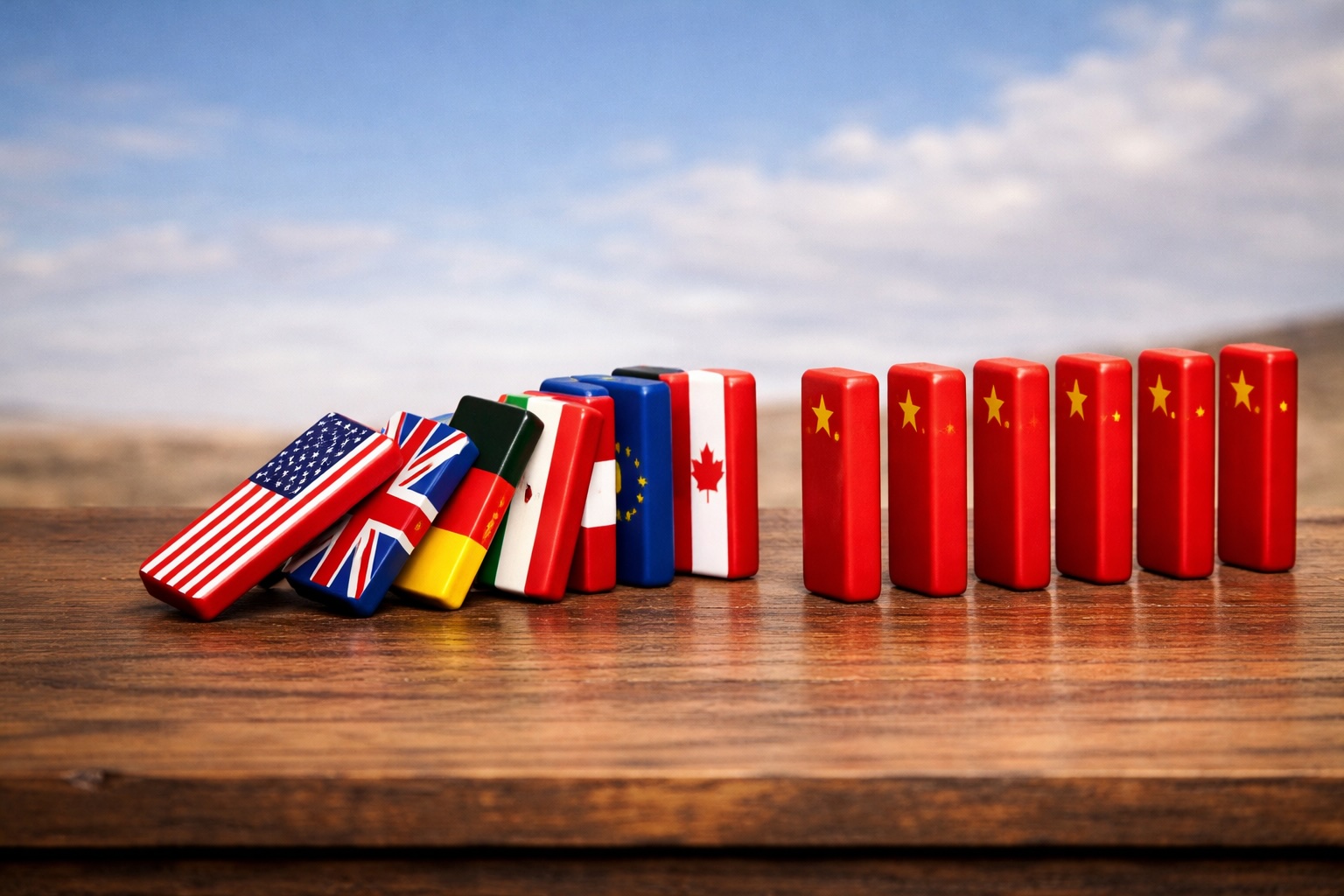
China Exploits Trump's Alliance Fractures: How Beijing Is Winning Without Fighting
As the Trump administration escalates confrontations with traditional American allies, Beijing is positioning itself as the steady hand in an increasingly turbulent global order. The strategy requires no dramatic gestures—only patience and the willingness to step into the diplomatic vacuums Washington leaves behind.
The Davos Contrast
Hours before Donald Trump arrived at the World Economic Forum on January 21, 2025, Chinese Vice Premier He Lifeng delivered a carefully calibrated address that drew an unmistakable contrast with American foreign policy. While Trump continued his provocative declarations about acquiring Greenland and threatened European nations with punitive tariffs for opposing his territorial ambitions, He Lifeng struck an altogether different tone.
The Chinese message emphasized multilateralism, free trade, and a preference for cooperation over confrontation. None of this rhetoric is new—Xi Jinping has articulated similar themes for years as part of his broader campaign to reshape an international order he views as structurally biased toward American interests. What has changed is the receptiveness of the audience. European and Asian leaders who once dismissed such overtures as hollow propaganda are now listening with genuine interest, not because their suspicions of Beijing have diminished, but because their confidence in Washington has eroded.
The Greenland controversy illustrates this dynamic with particular clarity. Trump's insistence that Denmark should cede the territory—backed by threats of economic retaliation—has created friction not merely with Copenhagen but with the entire NATO alliance. For Beijing's strategists, this represents an unexpected gift. Every transatlantic dispute weakens the coalition that China views as its primary strategic constraint, and unlike previous administrations that worked to repair such rifts, Trump appears intent on widening them.
Canada's Remarkable Pivot
Perhaps no development at Davos captured this shifting landscape more vividly than the remarks of Canadian Prime Minister Mark Carney. In a speech that would have been unthinkable from a Canadian leader even two years ago, Carney directly challenged the concept of a rules-based international order, describing it as a framework that primarily served the powerful while allowing them to exempt themselves from its constraints whenever convenient.
Though Carney avoided naming the United States explicitly, his target was unmistakable. More striking still was the resonance between his critique and arguments Beijing has deployed against Western institutions for decades. The Canadian prime minister was not endorsing the Chinese worldview—he began his remarks with references to Soviet authoritarianism—but he was adopting its analytical framework, and that distinction matters less than it might appear.
The context surrounding Carney's speech amplifies its significance. Days before Davos, he had completed a visit to Beijing where he announced a new strategic partnership and relaxed tariffs on Chinese electric vehicles that Canada had previously imposed in coordination with Washington. This represented a meaningful departure from the tight alignment with American trade policy that had characterized Canadian economic strategy. Combined with Trump's recurring references to Canada as a potential "51st state," the visit signaled that Ottawa is actively exploring alternatives to its traditional dependence on the American relationship.
Carney's invocation of a "new world order" taking shape may have been rhetorical, but in Beijing it registered as confirmation of a thesis Chinese officials have long advanced: that American hegemony rests on alliance structures that are more fragile than they appear, and that sufficient pressure—whether applied by China or by America's own leaders—can cause them to fracture.
Britain Recalibrates
Similar recalculations are underway across the Atlantic. The Starmer government has reopened high-level channels of communication with Beijing after years of increasing tension under Conservative leadership. The prime minister has spoken publicly about the necessity of greater engagement with China, framing it as pragmatic recognition of economic and geopolitical realities rather than ideological alignment.
The most concrete manifestation of this shift is the approval of a new Chinese embassy complex near London's financial district. The decision provoked criticism from security hawks and human rights advocates, but it proceeded nonetheless—a signal that commercial and diplomatic considerations are gaining weight relative to strategic concerns about Chinese influence.
These moves should not be mistaken for a fundamental realignment of British foreign policy. London remains deeply integrated into Western security architecture and continues to harbor substantial reservations about Chinese ambitions, from economic practices to Taiwan. What has changed is the cost-benefit calculus. With Trump threatening NATO's foundational commitments and raising the prospect of trade barriers against European goods, British policymakers are hedging their bets. Maintaining functional relationships with Beijing offers insurance against an American partner who has become disturbingly unpredictable.
The Economic Dimension
Beneath the diplomatic maneuvering lies a stark economic reality that shapes every government's calculations. China recorded a trade surplus exceeding $1.2 trillion in 2024, a figure that represents both the engine of Chinese strategic influence and a source of mounting concern in European capitals. Industries across the continent face competitive pressure from Chinese exports, and the surplus's scale raises questions about the sustainability of current trade relationships.
Emmanuel Macron touched on this issue in his Davos address, but the topic received less attention than it might have in other circumstances. The uncertainty generated by American threats to NATO dominated private conversations, pushing economic concerns into the background—at least temporarily. This ordering of priorities itself represents a victory for Beijing. When European leaders are more worried about whether Washington will honor its security commitments than about Chinese trade practices, China's negotiating position strengthens considerably.
He Lifeng's assurance that China "does not seek trade surpluses" should be understood in this context. The claim strains credulity given the observable data, but its purpose is not to persuade through evidence. Rather, it establishes a narrative frame in which China presents itself as a willing partner for mutually beneficial economic cooperation, available to any nation that finds its current arrangements unsatisfactory. The audience for this message is not economists but politicians weighing their options in an increasingly uncertain environment.
Strategic Patience as Grand Strategy
The most striking aspect of China's current approach is its restraint. Beijing is not launching diplomatic offensives or making dramatic overtures to peel away American allies. It is simply maintaining course while allowing American policy to generate its own centrifugal forces within the Western alliance.
This strategy reflects a calculation within the Chinese leadership that spectacular initiatives are unnecessary and potentially counterproductive. Aggressive moves toward Europe or traditional American partners would trigger defensive reactions and potentially reunify the Western coalition around shared concerns about Chinese ambitions. Passive availability—the quiet signal that Beijing remains open for business with any government seeking alternatives—achieves the same objective without the risks.
The approach also reflects lessons learned from previous cycles of Western concern about China. In the past, moments of peak anxiety about Chinese influence have often been followed by periods of accommodation as commercial interests reasserted themselves. Beijing's strategists appear confident that this pattern will repeat, particularly if American behavior continues to alienate the allies whose cooperation is essential to any sustained effort to constrain Chinese power.
The Limits of the Opening
None of this should be interpreted as evidence that China has won some decisive strategic victory or that Western alignment with Beijing is imminent. The fundamental concerns that have driven increasing skepticism toward China—its treatment of Xinjiang, its posture toward Taiwan, its economic practices, its expanding military capabilities—have not disappeared. They have been temporarily overshadowed by more immediate anxieties about American reliability, but they remain latent and could resurface rapidly under different circumstances.
European governments engaging with Beijing are pursuing tactical diversification, not strategic realignment. They are creating options and preserving maneuverability in an environment where their traditional security guarantor has become a source of instability rather than reassurance. This is a significant development, but it falls well short of a fundamental reordering of global alignments.
Moreover, Trump's approach may prove less durable than it currently appears. American foreign policy has undergone dramatic shifts before, and the institutional and economic ties binding the transatlantic relationship are deeper than any single administration's preferences. A future American government might repair much of the damage and restore the coordination that made Western policy toward China more coherent and effective.
The Window and Its Uncertainties
What Beijing perceives in the current moment is a window of opportunity—not to achieve final victory in its competition with the United States, but to incrementally improve its position while the costs of doing so remain low. Every relationship deepened with a European government, every trade agreement signed with a nation previously aligned with American preferences, every diplomatic channel opened while Washington alienates its partners represents a modest but meaningful advance.
The uncertainty surrounding this window concerns its duration and ultimate significance. If Trump's approach represents a lasting transformation of American foreign policy, the incremental gains China is accumulating could compound into something more substantial. If it proves to be an aberration followed by a restoration of traditional American alliance management, much of what Beijing gains in this period may be reversed.
Chinese strategists appear to be betting that even a partial and temporary weakening of Western cohesion will yield lasting benefits. Habits of independent engagement with Beijing, once established, may prove difficult to abandon entirely. Trust in American reliability, once damaged, may never fully recover. The structures of the post-World War II international order, once questioned by their own architects, may never regain their previous authority.
These are speculative propositions, not certainties. What is clear is that Beijing intends to test them, and that American policy under Trump is providing an unusually favorable environment for the experiment.