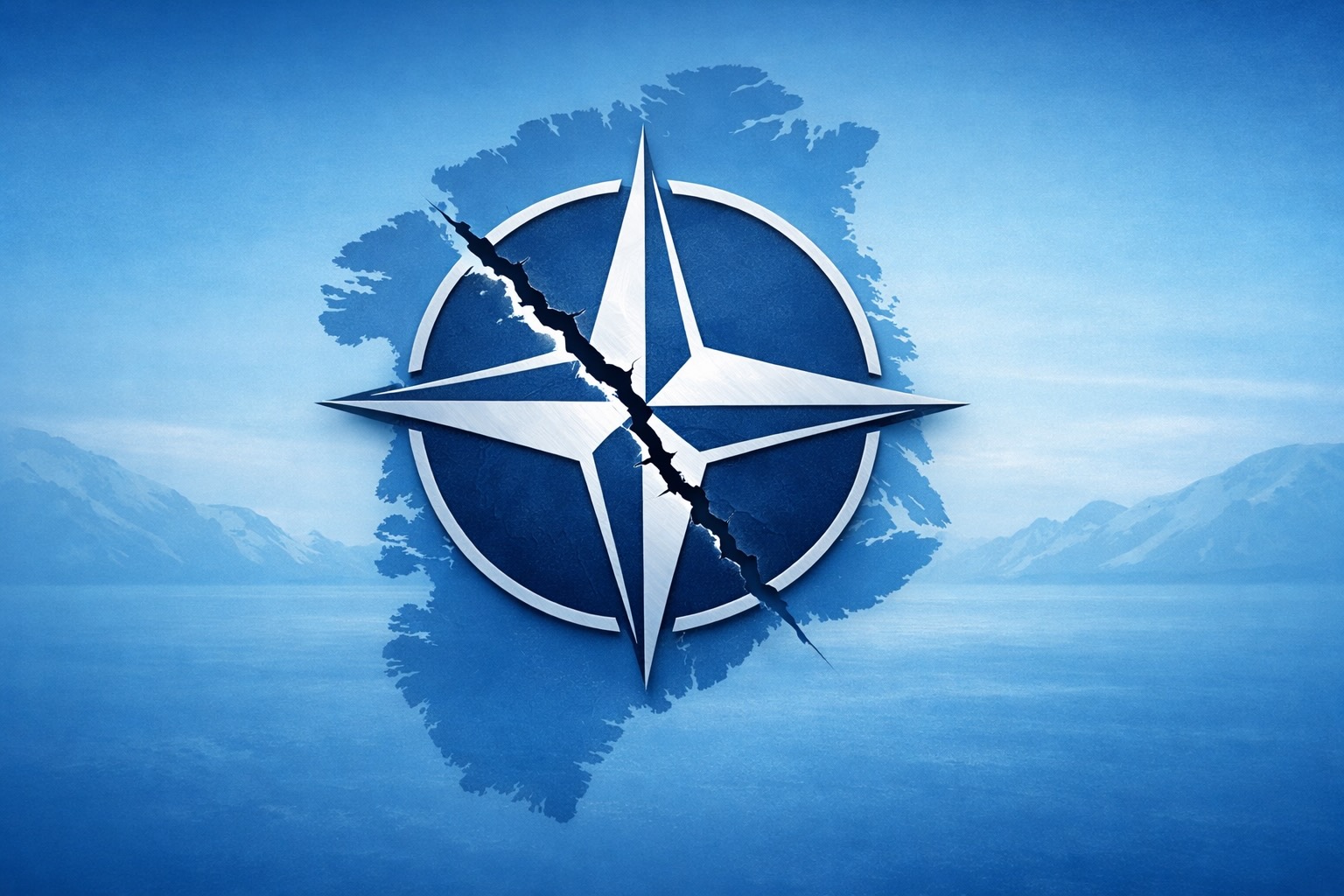
Trump's Greenland Threats Are Doing What the Soviet Union Never Could: Breaking NATO
The Kremlin's Forty-Year Dream Realized
For over four decades, the Soviet Union deployed every tool in its arsenal to fracture the North Atlantic Alliance. Ultimatums, walls, missiles, and diplomatic gambits—all aimed at driving a wedge between Washington and its European partners. Every effort failed. Yet what Soviet premiers could not achieve through sustained pressure and nuclear brinkmanship, Donald Trump may be delivering through sheer belligerence toward America's closest allies.
"The Soviet Union struggled for more than 40 years to achieve what has just been handed to Vladimir Putin on a plate," observes David Blair, chief international affairs commentator for the British Telegraph. The assessment is blunt, but the evidence is mounting.
Cold War Lessons Forgotten
The Kremlin's playbook during the Cold War was remarkably consistent: exploit every crisis to test NATO's cohesion. When Nikita Khrushchev issued his 1958 ultimatum demanding Western withdrawal from Berlin, the goal was not merely territorial—it was to expose fractures in the alliance. The construction of the Berlin Wall in 1961 served a similar purpose. Khrushchev reportedly boasted that "Berlin is the West's testicles. Every time I want to make the West squeal, I squeeze Berlin."
His successor, Leonid Brezhnev, escalated the pressure by deploying a new generation of intermediate-range ballistic missiles across Soviet satellite states in Central Europe. The SS-20 missiles, capable of striking Western European capitals with nuclear warheads, were designed as much for psychological division as military advantage. Moscow calculated that Europeans, facing annihilation while America remained safely across the Atlantic, might eventually demand accommodation with the Soviet Union.
Yet NATO held. Through the Cuban Missile Crisis, the Prague Spring, détente and its collapse, the Euromissile crisis, and countless smaller confrontations, the alliance maintained its fundamental unity. American presidents from Eisenhower to Reagan understood that NATO's strength derived not from military hardware alone, but from the unshakeable belief—held by allies and adversaries alike—that an attack on one would be treated as an attack on all.
Putin's Patient Campaign
Vladimir Putin inherited this ambition when he consolidated power at the turn of the millennium. For twenty-five years, he has probed NATO's defenses—not primarily through military means, but through information warfare, energy manipulation, and diplomatic wedge-driving.
Before launching his full-scale invasion of Ukraine in February 2022, Putin spent years constructing a narrative that cast NATO itself as the aggressor. The alliance, he claimed, was "encircling" Russia, positioning forces ever closer to Russian borders in violation of alleged promises made during German reunification. The very existence of NATO, in this telling, constituted a threat to world peace—as if sovereign nations exercising their right to choose their own security arrangements somehow justified Russian aggression.
The invasion of Ukraine was meant to demonstrate NATO's impotence, expose European dependence on Russian energy, and ultimately convince the West that accommodating Moscow's demands was preferable to confrontation. Instead, the war galvanized the alliance. Finland and Sweden abandoned decades of neutrality to seek NATO membership. European nations dramatically increased defense spending. American military aid flowed to Kyiv in unprecedented volumes.
Putin's gambit appeared to have backfired catastrophically. NATO emerged more unified than at any point since the Cold War's end.
Then came Donald Trump's second term.
The Greenland Ultimatum
Trump's demand that Denmark cede Greenland to the United States would be extraordinary under any circumstances. That a sitting American president is threatening a NATO ally with economic coercion—and has refused to rule out military force—to seize territory that ally has governed for centuries defies the foundational principles of the Western alliance.
Greenland's strategic value is undeniable. The island sits astride critical Arctic shipping lanes that climate change is rendering increasingly navigable. Its subsurface contains vast deposits of rare earth minerals essential to modern technology and green energy infrastructure. The United States already maintains Pituffik Space Base (formerly Thule Air Base) on the island, a crucial node in America's early warning and space surveillance networks. Control of Greenland would significantly enhance American strategic positioning vis-à-vis both Russia and China in an increasingly contested Arctic.
None of this justifies threatening an ally.
On Saturday, Trump escalated the confrontation by imposing punitive tariffs on at least eight allied nations, including the United Kingdom. Their offense? Stating the obvious: that Greenland's status is a matter for its inhabitants and the Danish government to determine. Norway's Prime Minister Jonas Gahr Støre received a particularly bizarre message in which Trump complained about being denied the Nobel Peace Prize, adding that he therefore "no longer feels obliged to think exclusively about peace."
The American president declared that Denmark possesses no "property rights" over Greenland and that "complete and total control" by the United States is essential for global security. The language—property rights, complete control—reflects a transactional worldview fundamentally at odds with the principles of sovereignty and mutual respect upon which NATO was built.
Europe Reaches for the Bazooka
Confronted with sustained American pressure, the European Union is preparing to respond with measures previously reserved for hostile powers. The European Anti-Coercion Instrument, informally known as the "trade bazooka," was designed to counter economic bullying by authoritarian regimes. It has never been deployed. Now Brussels is actively considering activating it—not against China, not against Russia, but against the United States.
The potential scope is staggering: tariffs and restrictions affecting more than €90 billion in American exports to Europe. Such measures would represent an unprecedented rupture in transatlantic economic relations, with cascading effects across global supply chains, financial markets, and diplomatic relationships.
"This emergency measure, which has never been used before, is very likely to be used not against China or any other rival, but against the superpower that has guaranteed Europe's security for almost 80 years," Blair notes. The EU's willingness to even contemplate such action signals how fundamentally Trump has altered the transatlantic relationship.
The Trust Deficit
British Prime Minister Keir Starmer spoke for many European leaders when he declared from Downing Street: "Alliances endure because they are built on respect and cooperation, not pressure. The use of tariffs against allies is completely wrong."
The statement captures the essence of what Trump appears not to understand—or not to care about. Military alliances are not mere commercial arrangements to be renegotiated at will. They rest on shared values, mutual trust, and the credible commitment to collective defense. Once that trust is shattered, it cannot easily be restored.
Consider the position of European defense planners today. For decades, NATO strategy has rested on the certainty that American military power would respond to any attack on alliance territory. Soviet leaders knew that invading Western Europe meant war with the United States—a war they could not win. This certainty deterred aggression and kept the peace.
What certainty can European planners have now? If the American president openly threatens allies, imposes economic punishment for mild disagreement, and pursues territorial claims against allied nations, what confidence can anyone have in American security guarantees? As Blair asks: "Why should Putin believe this now?"
Moscow Watches and Waits
Vladimir Putin need not lift a finger. The division he has sought for a quarter-century is materializing without Russian involvement. The American president is accomplishing what generations of Soviet and Russian leaders could not: turning the transatlantic allies against each other.
Even if this particular crisis eventually resolves through some face-saving compromise on Greenland—which remains the most likely outcome—the damage may prove irreparable. Future European leaders will remember that the United States, under Trump, was willing to threaten allies with economic devastation and military force to pursue territorial ambitions. Future American presidents will inherit a Europe that has learned it cannot rely on Washington.
The Russian president, who has spent his career studying Western weaknesses and exploiting divisions, surely recognizes the magnitude of this gift. He can observe NATO fragmenting not through any action of his own, but through the choices of its leading member. He can watch as European nations contemplate economic warfare against their traditional protector. He can note the erosion of trust that no diplomatic communiqué or summit photograph can restore.
The Stakes Beyond Greenland
The current crisis is not fundamentally about an Arctic island, however strategically valuable. It is about whether the Western alliance—the most successful security arrangement in modern history—can survive a fundamental challenge from within.
NATO's Article 5 guarantee of collective defense has been invoked exactly once in the alliance's seventy-five-year history: after the September 11 attacks, when European allies rushed to support the United States. European soldiers fought and died in Afghanistan alongside Americans for two decades. That history of shared sacrifice is being squandered.
The implications extend far beyond transatlantic relations. China watches closely as America's credibility with allies erodes. Smaller nations calculating their alignment in an era of great power competition observe how the United States treats even its closest partners. The message is unmistakable: American commitments are conditional, American friendship is transactional, and American protection comes with strings attached.
This may serve Putin's immediate interests. It may even serve certain narrow American interests in the short term. But it undermines the international order that has preserved great power peace and enabled unprecedented prosperity since 1945. That order was built on American leadership, reliability, and commitment to allies. All three are now in question.
A Self-Inflicted Wound
The tragedy is that none of this was necessary. America's legitimate strategic interests in the Arctic could have been advanced through cooperation with Denmark, investment in Greenland's development, and strengthened security partnerships. Instead, Trump chose confrontation, ultimatums, and threats.
The Soviet Union failed to break NATO because American leaders understood that the alliance's value far exceeded any short-term gain that might come from abandoning partners. They recognized that credibility, once lost, is nearly impossible to rebuild. They grasped that the Western alliance was not merely a military arrangement but an embodiment of shared values and mutual commitment.
Those lessons, learned through decades of Cold War confrontation, appear to have been forgotten. The gift to Putin was not inevitable. It was chosen.
The consequences of that choice will unfold over years and decades. But one thing is already clear: the alliance that deterred Soviet aggression for forty years and provided the foundation for European peace and prosperity faces its gravest internal challenge since its founding. Vladimir Putin, who has devoted his career to weakening the West, could hardly have asked for more.