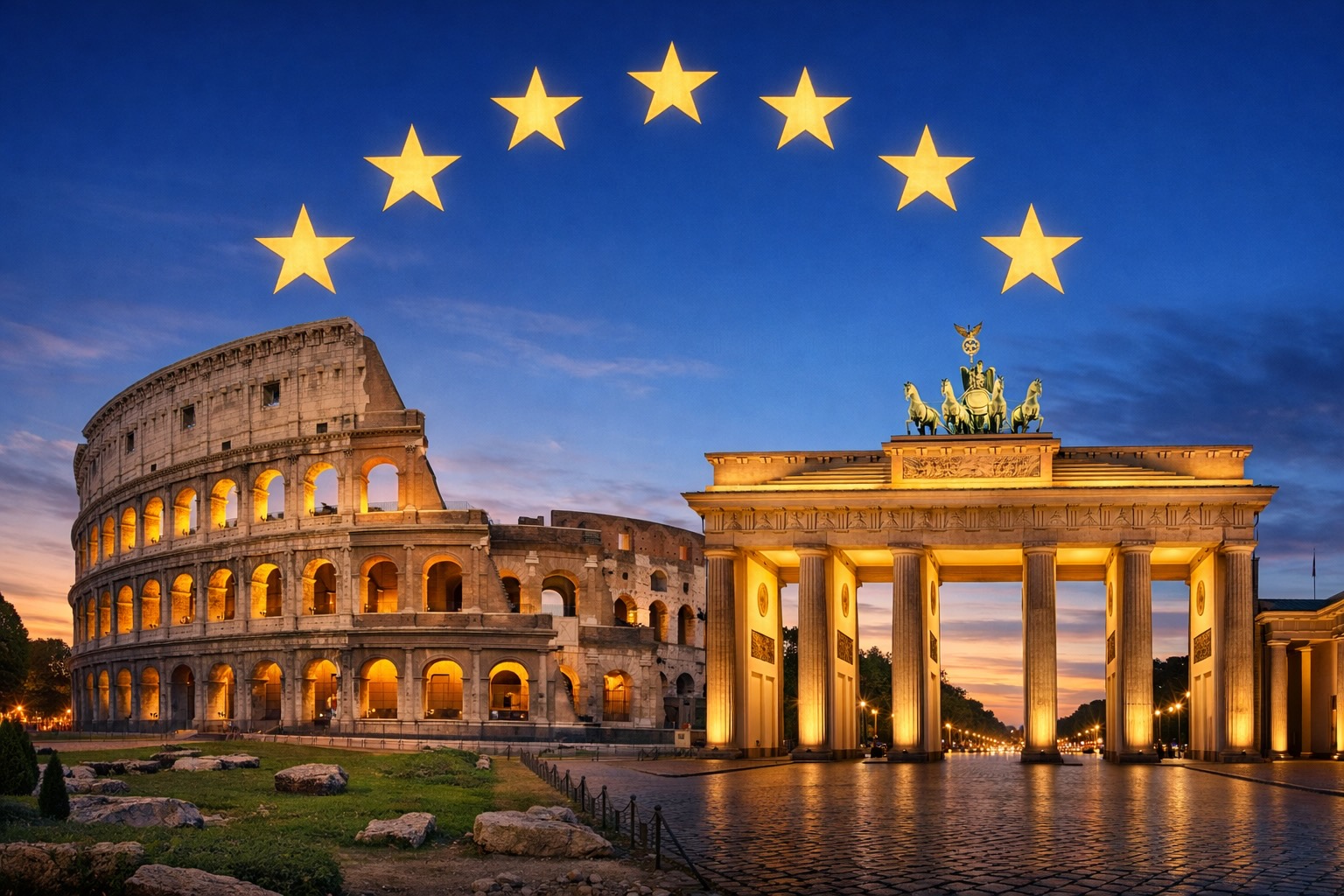
Merz and Meloni Form New EU Power Axis as Franco-German Alliance Weakens
A Strategic Realignment in European Politics
The intergovernmental summit held in Rome on January 2025 may well be remembered as a turning point in European political architecture. Italy and Germany—two founding members of the European project—signed a joint action protocol in the presence of Prime Minister Giorgia Meloni, Chancellor Friedrich Merz, and an unprecedented twenty-two ministers from both governments. The sheer scale of ministerial participation signals that this was no routine diplomatic exercise but rather a deliberate demonstration of strategic alignment at the highest levels.
The symbolism was unmistakable: Europe's traditional Franco-German engine is sputtering, and a new Rome-Berlin axis is emerging to fill the vacuum.
The Protocol: Security, Integration, and Transatlantic Bonds
The joint action protocol commits both nations to strengthening existing security architectures—NATO, the European Union, the United Nations, and the OSCE—while emphasizing that current global instabilities demand enhanced cooperation, particularly in security and defense. Both governments stressed their responsibilities as EU founding members and their commitment to enabling the Union to function more effectively in an increasingly volatile international environment.
Central to the agreement is the reaffirmation of transatlantic ties. Both leaders emphasized the "fundamental importance" of a strong relationship between Europe and the United States, grounded in shared values and interests. This positioning is hardly accidental; it represents a calculated alignment ahead of potential shifts in American foreign policy under President Trump's administration.
Meloni captured the moment's significance: "Italy and Germany are closer today than ever before. This is good news for our peoples and for Europe as a whole." She framed Europe as standing at a "particularly complex historical juncture," facing a choice between becoming "the protagonist of its own destiny" or passively accepting whatever fate befalls it.
Merz, for his part, noted the 75-year history of diplomatic relations between the two countries while emphasizing that the foundations for deeper cooperation have never been stronger. "We want this year to be a year of opportunities and decisions," he declared, highlighting a "natural, similar approach" shared by both nations in assessing the challenges confronting European democracies.
Why Germany Is Looking South
The question observers across Europe are asking is straightforward: why is Berlin pivoting toward Rome at a moment when the Franco-German partnership has historically defined EU direction?
The answer lies in a confluence of frustrations, pragmatic calculations, and personal chemistry.
The Mercosur Fracture
Germany has long championed the EU-Mercosur trade agreement as a vehicle for expanding industrial exports to South America. France, under pressure from its agricultural lobby, attempted to undermine the deal—a move that infuriated Berlin. German Foreign Minister Johann Wadewall articulated the shift in priorities: "When Berlin and Rome work closely together, they do so not out of routine, but out of conviction, because the future of Europe, its freedom and its power to shape the world depend on it."
The joint position paper prepared by Rome and Berlin for the February European Council summit refers to Italy and Germany as "Europe's two main industrial countries" and explicitly criticizes delays in the Mercosur agreement. This language is a pointed rebuke to Paris.
Defense Industrial Convergence
Germany is reportedly considering withdrawal from a €100 billion joint fighter jet program with France due to persistent disagreements. Meanwhile, German defense giant Rheinmetall and Italy's Leonardo have established a joint venture for tanks and military vehicles. The Rome summit produced a formal defense cooperation agreement, with approximately ten bilateral agreements signed in total.
This defense industrial alignment represents more than commercial convenience. It reflects a shared vision of European security that prioritizes interoperability with NATO systems and maintains close coordination with Washington—a vision that has occasionally clashed with French aspirations for greater European strategic autonomy.
The Macron Factor
Both Merz and Meloni appear increasingly exasperated with Emmanuel Macron. Italian parliamentarian Gian Giacomo Calovini, who chairs the Italian-German friendship group, accused the French president of "contradictory" behavior toward Trump: "He acts as if he wants to provoke the United States, but then sends messages—which Trump published in a not very elegant way—begging Trump to invite him to dinner."
With French presidential elections looming and Macron's political capital depleted, Rome and Berlin are betting on stability. "Our two countries have stable governments, especially compared to France," Calovini observed. "It is clear that Meloni and Merz probably still have a long way to go, during which they can work together."
The Trump Variable
Managing relations with Washington has become a critical priority for European capitals, and here Meloni and Merz have found common ground. Both leaders have cultivated constructive relationships with the Trump administration while avoiding the confrontational postures that have characterized some European responses.
Former Italian ambassador Pietro Benassi noted that "Giorgia Meloni and Friedrich Merz represented the European wing that was most open to dialogue with President Trump." The acceleration of geopolitical events under American pressure has reinforced the convergence between Rome and Berlin while exposing divergences with Paris.
This transatlantic orientation extends to their respective foreign ministers. Antonio Tajani and Johann Wadewall have worked to maintain open channels with Washington, positioning Italy and Germany as potential bridges between Europe and the United States at a moment of transatlantic tension.
Ukraine and the Limits of Alignment
The partnership is not without friction. Meloni declined to support Merz's proposal to use frozen Russian assets to finance military aid to Ukraine—a significant divergence on one of Europe's most pressing security questions. Both leaders affirmed that Europe "must continue to work for peace" and committed to supporting Kyiv, including through energy assistance during the harsh winter, but the asset seizure disagreement reveals differing risk calculations regarding escalation and international law.
Fiscal Tensions Beneath the Surface
Perhaps the most significant long-term challenge to the Rome-Berlin axis lies in fiscal policy. Italy has historically advocated for relaxed European fiscal rules and is allied with France on this issue, while Germany has traditionally resisted expanded EU spending and debt mutualization.
However, even here the ground has shifted. Meloni has implemented spending cuts that have improved Italy's fiscal trajectory, while Merz has presided over a historic expansion of debt-financed infrastructure and defense spending—a dramatic departure from German fiscal orthodoxy. This unexpected convergence has narrowed, though not eliminated, the gap between the two capitals.
Former diplomat Stefano Stefanini cautioned that structural limits remain: "In terms of defense spending, Italy and France are closer because Germany has the fiscal capacity to spend on its own, while Italy and France need to get as much financial support as possible from the EU."
Ideological Convergence Through Domestic Necessity
The Merz-Meloni partnership is partly a product of domestic political evolution in both countries. Meloni has moderated her nationalist Brothers of Italy party, particularly on foreign policy, moving toward the European mainstream while retaining her base. Simultaneously, the rise of the Alternative for Germany (AfD) has pushed Merz's conservatives rightward on immigration, creating ideological overlap where little existed before.
This convergence has enabled what analysts describe as a "normalization" of relations. As Merz sought European partners for his agenda—reducing asylum flows, cutting regulation, promoting trade—Meloni emerged as a natural ally rather than a problematic outlier.
Implications for EU Power Dynamics
The Rome-Berlin axis represents a potential restructuring of EU decision-making. For decades, the Franco-German motor drove European integration; major initiatives required Paris and Berlin to agree before moving forward. If the Merz-Meloni partnership solidifies, a competing power center emerges—one more skeptical of fiscal expansion, more aligned with NATO, and more accommodating of Washington.
Marc Lazar, an expert on Franco-Italian relations at Sciences Po, observed: "Meloni understood that, as there is some tension in relations between France and Germany, she could penetrate and get closer to Germany."
This triangular dynamic—with Italy positioned between France and Germany rather than excluded from the core—marks a significant shift in European political geography. Whether it endures will depend on election outcomes, economic performance, and the evolution of transatlantic relations.
Conclusion: A Partnership Born of Circumstance and Conviction
The Merz-Meloni partnership blends pragmatic calculation with genuine ideological affinity. Both leaders face domestic pressures that reward European cooperation; both see value in maintaining strong transatlantic ties; both are frustrated with French unpredictability. German officials describe the relationship with Rome as "reliable," while Italian counterparts praise the "good chemistry" between the two leaders.
Yet this remains a partnership of the moment, shaped by specific circumstances that could shift. French elections may produce a president more amenable to German priorities. Trump's policies may create wedges between Rome and Berlin. Fiscal disagreements may resurface as economic conditions evolve.
For now, though, the Rome summit delivered a clear message: the EU's center of gravity is shifting, and the traditional assumptions about who leads Europe require revision. In an era of polycrisis—war in Ukraine, migration pressures, industrial competition with China, and transatlantic uncertainty—Italy and Germany have chosen each other as their primary partners. The consequences of that choice will unfold across the continent in the months and years ahead.