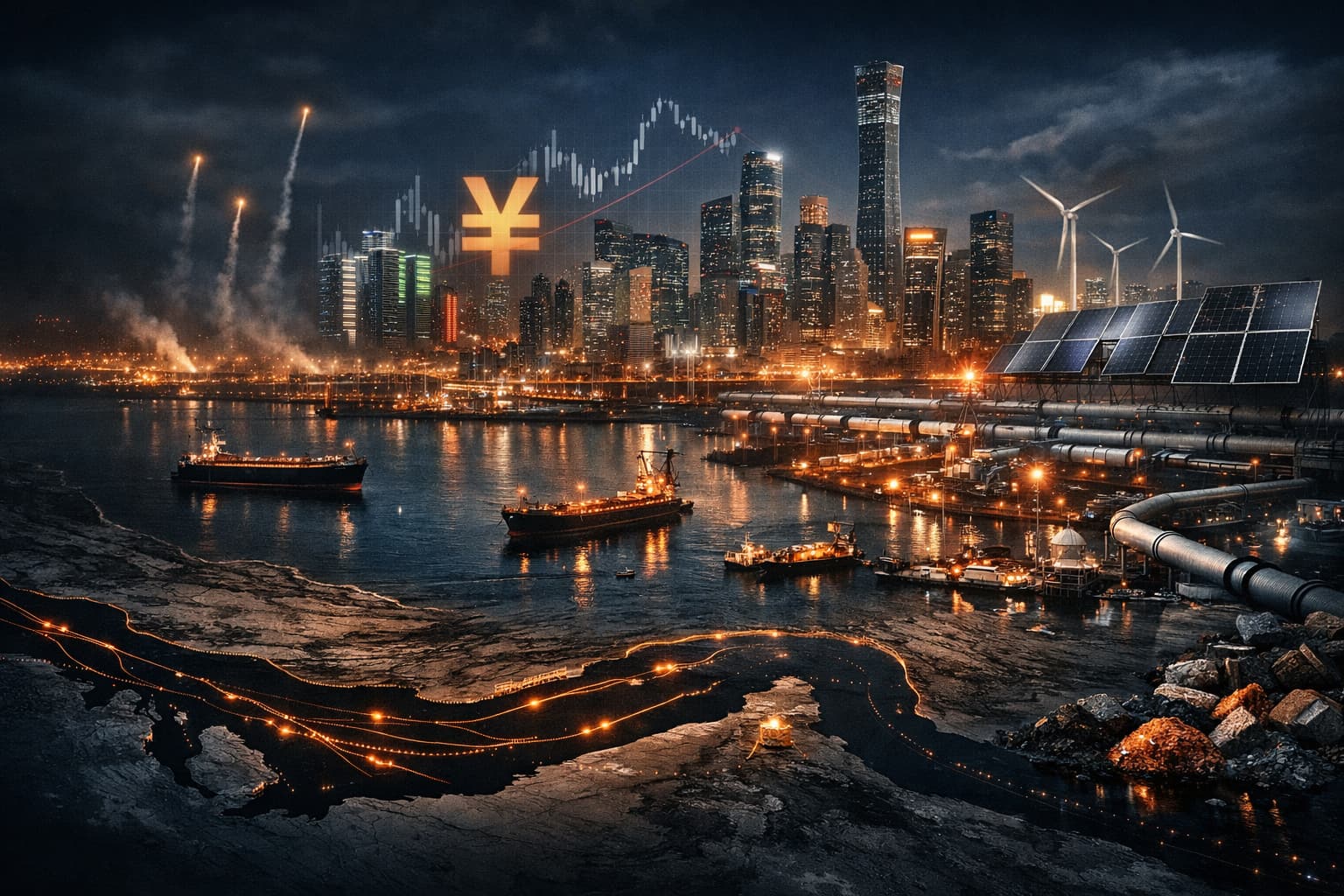
The war is cementing China's superpower status
When American and Israeli missiles struck Iranian targets on 28 February 2026, the working assumption in most Western capitals was that Beijing would be left scrambling. China buys roughly 90 percent of Iran's oil exports, sources close to half its imported crude from the Middle East, and has tied its industrial base to Gulf shipping lanes for decades. A war that closed the Strait of Hormuz, pushed Brent crude 10-13% higher to around $80-82 per barrel within days, and disrupted 20% of global oil supplies through Iran's closure of Hormuz looked tailored to expose Chinese vulnerabilities.
Six weeks in, the reverse is looking closer to the truth.
Beijing spent years preparing for precisely this disruption. The Iran conflict has not cracked the Chinese economy open. It has accelerated trends that position China to extract strategic advantage from the crisis that was supposed to humble it. That is the conclusion filtering out of Deutsche Bank research notes, analyses by Bruegel and the Washington Institute, and, quietly, inside Gulf governments themselves.
Begin with the obvious vulnerability: oil. China's oil imports hit record highs in 2025 at 11.55 million barrels per day, and something close to 5.4 million barrels of that daily flow normally moves through the Strait of Hormuz on its way to China. On paper, that should be a chokehold. In practice, it is not, because Beijing saw the hold coming years ago and chose to pre-empt it.
Through most of 2025, Chinese crude inventories grew by roughly 900,000 barrels per day between January and August, essentially acting as a source of demand by removing barrels from global markets and keeping Brent prices tightly pinned near $68 per barrel. Independent estimates now place China's combined strategic and commercial oil reserves at about 1.2 to 1.3 billion barrels, comprising roughly 400 million in strategic reserves and 800 million in commercial stocks. Storage capacity in aggregate has passed two billion barrels.
The timing was not accidental. Energy Aspects reported in mid-2025 that Beijing had quietly issued orders to state-owned oil companies since late 2023 to stockpile the fuel, including a 140 million barrel order with deliveries continuing until March 2026. State firms including Sinopec, CNOOC, and PetroChina are adding at least 169 million barrels of storage capacity across 11 new sites during 2025 and 2026. Reuters sources said the longer-term target is two billion barrels, enough to cover six months of net imports. When the strikes began on 28 February, the reserve system was closer to full than it had ever been.
Tehran, for its part, has played the card Beijing hoped it would play. According to reporting in Lloyd's List and confirmed by Chinese commercial diplomacy, ships tied to "non-hostile" partners are still being allowed through Hormuz. Available figures show that by 15 March, 11.7 million barrels of Iranian crude oil had moved from Iranian ports to Chinese refineries, not through the normal international shipping system that runs on dollar payments and Western insurance but through a shadow fleet of ships, with every single barrel settled outside the US dollar. The Strait is not blockaded. It is permissioned. And the price of admission is increasingly denominated in yuan.
Oil, however, is only the headline vulnerability. The deeper story is how little of China's energy mix actually rides through the Gulf.
Consider the pipelines. China consumes just over 400 billion cubic meters of natural gas annually. About 60 percent is produced domestically, while the remaining 40 percent is imported, with about half of imported gas arriving via pipelines, mostly from Russia and Turkmenistan. In 2025, China increased imports of Russian pipeline gas by 17.1% to $9.41 billion, with Turkmenistan ranking second at $8.41 billion, followed by Myanmar, Kazakhstan, and Uzbekistan. None of that flow depends on Gulf shipping, Suez transit, or Western-patrolled sea lanes. It arrives by land, under long-term contracts, on terms set largely by Beijing.
This matters more than it might appear. Europe, entering the conflict with storage at roughly 30 percent capacity after a harsh winter, has watched Dutch TTF gas benchmarks nearly double to over €60 per megawatt-hour. Qatari LNG, which supplies about a fifth of the global seaborne market, is largely bottled up. Any prolonged Hormuz closure tightens the screw on European and Japanese manufacturers who pay international spot prices. China, sitting on fixed-price pipeline contracts from Siberia and the Karakum, is largely insulated. Its exporters of steel, chemicals, ceramics, glass, and automotive components may end the war more, not less, competitive than they began it.
The electrification buffer
Even oil matters less to the Chinese economy than the raw import figure suggests, because the economy is electrifying faster than any comparable system in history. Electricity generation from renewable energy was about 35% of total electricity by 2025, while the country's clean electricity capacity reached 52% by February 2026, exceeding fossil fuel capacity for the first time. In 2025, renewable energy, including nuclear, surpassed oil as the country's second largest energy source, totaling more than 20 percent of total energy consumed.
The buildout is not slowing. China added a record 264 GW of wind and solar capacity in the first half of 2025 alone, with plans to add roughly 600 GW for the year, pushing total solar capacity past one terawatt for the first time. Wind capacity reached 704 GW by mid-2025. In the first half of 2025, wind and solar deployment was more than double H1 2024, and clean generation outstripped demand growth, resulting in a 2% fall in fossil generation compared with H1 2024. For the first time in modern Chinese economic history, growing the economy did not require burning more coal, oil, or gas.
That translates into strategic depth during a Gulf War. Bruegel analysts estimate that only about 6 to 8 percent of China's total energy consumption is directly exposed to a prolonged Hormuz disruption. Analogous figures for Japan, South Korea, or India sit three to four times higher. A country that generates a quarter of its electricity from wind and sun and that has built the grid infrastructure to transmit it across thousands of kilometers does not need to panic when a tanker insurance market seizes up in the Persian Gulf.
Where the war does not simply leave China insulated, it hands Beijing an offensive opening. The conflict has concentrated global attention on what it means to depend on imported hydrocarbons, and every capital watching the Brent price chart is now rethinking its supply chain. That is good news for a country that already dominates the alternative.
CATL and BYD collectively installed 659.5 GWh of EV batteries in 2025, accounting for 55.6% of the global total, with CATL holding a 39.2% global share and remaining the only battery provider globally with over 30% market share. Six of the world's top ten EV battery makers are Chinese. For solar panels, China's share across all manufacturing stages from polysilicon through modules exceeds 80 percent, and the world's top ten suppliers of solar photovoltaic manufacturing equipment are all Chinese. It also dominates wind power, accounting for 50 to 70 percent of manufacturing capacity for key components like nacelles, towers, and blades. By late 2025, China's solar manufacturing capacity reached 1,200 GW per year, more than the global yearly demand.
Investors noticed. CATL shares have added tens of billions of dollars in market value since late February, as Asian and European buyers rebuild their storage and EV supply chains around the assumption that oil dependence is not just economically painful but geopolitically dangerous. Every additional Gulf shock accelerates demand for exactly the products Chinese factories already make at scale.
The rare earths angle tightens this further. China accounts for roughly 70 percent of rare earth mining, 90 percent of separation and processing, and 93 percent of magnet manufacturing. On 9 October 2025, Beijing announced the strictest rare earth and permanent magnet export controls in its history, applying a foreign direct product rule that requires foreign firms to obtain licenses for any rare earth magnets containing even trace amounts of Chinese-origin materials. When Beijing tightened export approvals earlier in 2025, Ford had to idle its Chicago Explorer line because it could not get rare earth magnets for basic vehicle parts. Defense supply chains run even tighter than civilian automotive, with longer lead times and less room to improvise. F-35 fighter jets, Virginia- and Columbia-class submarines, Tomahawk missiles, radar systems, and Predator drones all depend on rare earth inputs.
In a war that is straining American munitions production and testing allied defense industrial bases, China holds a quiet but decisive grip on the metallurgy underneath the hardware. The Pentagon invested $400 million in MP Materials in July 2025 and has a ten-year offtake agreement for a future magnet facility, but by the industry's own estimate, meaningful non-Chinese magnet capacity is still years away. Beijing can tighten or loosen the valve at will, and every time it does, it reminds Western defense planners that the next decade of great-power competition will be fought partly in supply chains rather than on battlefields.
Then there is the monetary layer, which may matter most of all.
The petrodollar system has rested, since Henry Kissinger negotiated it in 1974, on a simple bargain: Gulf producers price oil in dollars and recycle their surpluses into US Treasuries, and in return, Washington underwrites Gulf security. Five weeks into the Iran war, every part of that bargain is under strain. While the US and Israeli militaries have degraded Iran's capabilities, the regime retains enough combat power to selectively close off the Strait of Hormuz unless countries negotiate safe passage and pay in Chinese yuan. The yuan saw an uptick in demand after Iran took control of the Strait and began accepting payments in China's currency, while China's Cross-Border Interbank Payment System recorded a single-day transaction record of 1.22 trillion yuan, roughly $179 billion, surpassing the one trillion mark for the first time.
This is not the death of the dollar, and anyone selling that story is getting ahead of the data. The greenback still accounts for roughly 57 percent of global foreign exchange reserves, and US capital markets remain the deepest and most liquid in the world. But the direction of travel has changed. China's alternative payment system, CIPS, the Cross-Border Interbank Payment System, processed the equivalent of US $245 trillion in yuan-denominated transactions in 2025 alone, a 43% increase from the year before. The yuan is now used to settle 30% of China's $6.2 trillion in global trade in goods, and when all cross-border payments are factored in, the yuan's share jumps to 53%. Deutsche Bank strategist Mallika Sachdeva has gone on record suggesting the conflict may be remembered as the catalyst for the early erosion of petrodollar dominance and the practical beginning of a petroyuan.
The opportunity beyond the war
The other piece of the puzzle is reconstruction. Whenever the Iran war ends, the rebuild bill across damaged infrastructure in Iran, in Iraq, in Lebanon, and likely in parts of the Gulf will run into the hundreds of billions. It is hard to imagine a country better positioned to underwrite it than China. Over the past two decades, China has accumulated about $270 billion worth of investments and construction projects in the Middle East, spanning ports, industrial zones, energy infrastructure, and technology partnerships, many of them linked to the Belt and Road Initiative. Chinese firms already operate port concessions from Khalifa in the UAE through Duqm in Oman to Jizan in Saudi Arabia. Beijing is the only major power with working relationships across Tehran, Riyadh, Abu Dhabi and Tel Aviv, and it is not a combatant in the war.
That last point is doing quiet political work. Gulf officials who watched the US Fifth Fleet prove unable to keep the Strait open are now openly discussing what a hedged security architecture might look like. Beijing's five-point peace initiative with Pakistan, issued on 31 March, was deliberately modest in ambition but carefully timed. It framed China as the adult in the room for ceasefire, shipping security, and civilian protection, while Washington was still arguing with Tehran about whether ceasefire talks would continue.
None of which is to say the war carries no cost for Beijing. It does. Teapot refineries, the small private plants that depend on discounted Iranian crude, are facing high replacement prices in a market already strained by global tensions after losing access to low-cost crude when Iranian production and exports collapsed amid infrastructure damage. Higher transport costs, elevated insurance premiums, and backlogs at Gulf ports are biting into Chinese exports that grew rapidly in 2025, such as cars to the UAE, steel to Saudi Arabia, and electronics across the region. A prolonged Hormuz closure beyond the end of March could add between 0.4 and 0.8 percentage points to global inflation rates and slow growth, which ultimately means fewer Western and emerging-market buyers for Chinese goods.
The image problem is real too. Many of China's trading partners remain uncomfortable with its structural trade surpluses, and any perception that Beijing is profiting from a Middle Eastern war will feed the political case for the tariffs and industrial subsidies already aimed at Chinese EVs, batteries, and solar panels in the European Union, India, and parts of Southeast Asia. China's offer to mediate has been politely received, but it has not translated into meaningful diplomatic authority; Israel, wary of Beijing's Iran ties, has kept it at arm's length.
But those are second-order costs, and they are measurable against a first-order strategic gain. A country that has spent two decades investing in strategic reserves, pipeline diversification, clean energy manufacturing, rare earth dominance, and yuan-denominated settlement infrastructure is precisely the country best positioned to absorb, and exploit, a Middle Eastern war. If anything, the crisis has validated the entire logic of the Chinese industrial policy playbook: concentrate production in the sectors that will matter when the shocks come, and ensure that the West depends on you for them when they do.
A final point, one that tends to get lost amid the headlines about oil prices and missile strikes. The petrodollar system worked for half a century because the United States could credibly promise to keep the sea lanes open. The Iran war has shown, in the most literal possible way, that it can no longer keep a single strait closed. The country that has been most systematically preparing for that moment is outside the Gulf. It is in Beijing. Anyone who still believes this war is weakening China should pay closer attention to what the Chinese have been building, quietly and relentlessly, since the last time Washington declared that a new century of American primacy was underway.