E.H. Harriman: The Railroad Titan Who Crashed Wall Street and Built an Empire
He was born poor. He became a titan. And he lit the fuse of panic. The man who sent a stock from $110 to $1,000 in seventeen hours of trading.
He wasn't born rich. He didn't inherit an empire. He was the son of an Episcopal clergyman from Hempstead, Long Island—a man his son regarded, despite his extensive education, as someone who had done very little with his life. The boy left school at fourteen and entered Wall Street through the back door, as an errand boy. There, amid the roar of the trading floor, he learned the only lesson that would ever matter to him: power is not given—it is taken.
 This is the story of Edward Henry Harriman, born February 20, 1848. No one could have imagined then that this boy would become one of the most controversial titans of the American economy—a man who would turn the railroad into a weapon of imperial ambition, Wall Street into a battlefield, and the stock market into a theatre of war between competing industrial empires. To Americans living at the turn of the twentieth century, his name carried the same weight as J.P. Morgan, John D. Rockefeller, and Andrew Carnegie. Morgan stood for banking. Rockefeller for oil. Carnegie for steel. Harriman stood for railroads—and for the raw, relentless force of will that made them instruments of national power.
It was an age when America ran on rails. And Harriman would learn, faster than almost anyone, how to control them.
From the School Desk to the Trading Floor
At fourteen, he drops out of school. It is not a romantic rebellion against knowledge—young Harriman had actually won the top prize for scholarship at Trinity School in New York City just the year before. But academic pursuits could not contain him. It is a matter of ambition, not survival. He gets a job as a messenger at a brokerage firm on Wall Street, aided by his uncle, Oliver Harriman, who had already established a career there.
There, amid the shouting, the cigar smoke, and the papers changing hands at breakneck speed, he discovers the world that will swallow him up—and make him famous. He is methodical, alert, and ferociously attentive to detail. By the age of twenty-two, he has saved and earned enough to purchase his own seat on the New York Stock Exchange—an extraordinary achievement for a young man with no family fortune behind him.
At twenty-one, during the panic of "Black Friday" in 1869—when Jay Gould and James Fisk attempted to corner the gold market, the price collapsed, and the country watched in shock—young Harriman is not swept away. He sees opportunity where others see chaos. His early investments prove shrewd. It is his first "coup." It will not be his last.
In 1879 came the marriage that would change everything. He wed Mary Williamson Averell, daughter of William J. Averell, a banker in Ogdensburg, New York, who also served as president of the Ogdensburg and Lake Champlain Railroad Company. The match was both personal and strategic: it gave Harriman intimate access to the railroad world and introduced him to the mechanics of an industry that was reshaping the American continent. Together they would have six children, among them W. Averell Harriman, who would go on to serve as U.S. Ambassador to the Soviet Union, Secretary of Commerce under Truman, Governor of New York, and a key diplomatic figure of the Cold War era. The dynasty Harriman built would extend far beyond the rails.
The Rebuilder of Broken Railroads
Two years after his marriage, in 1881, Harriman made his first direct move in the railroad business. He purchased the Lake Ontario Southern Railroad—a bankrupt, broken-down thirty-four-mile line—renamed it the Sodus Bay & Southern, reorganized its operations, and sold it at a considerable profit to the Pennsylvania Railroad. It was a small transaction, but it revealed the template that would define his career: buy distressed, fix relentlessly, and sell—or keep—at a premium.
This was the start of his reputation as a reviver of failing railroads. In 1883, at the age of thirty-five, his growing connections in the industry earned him a seat on the board of directors of the Illinois Central Railroad, placed there by the road's president, Stuyvesant Fish. Within a few years, Harriman had left his brokerage firm entirely to become vice president of the Illinois Central. He was no longer a Wall Street observer betting on railroads from the outside. He was inside the machine.
But the Illinois Central was merely a prelude. The main act was about to begin.
The Resurrection of the Union Pacific
The Union Pacific Railroad was a wreck. By the mid-1890s, the road that had been the western half of America's first transcontinental railroad was bankrupt, languishing in government receivership after the devastating Financial Panic of 1893. No one wanted to touch it—not even J.P. Morgan.
Harriman did. In 1897, at nearly fifty years of age, he became a director of the Union Pacific. By May 1898, he was chairman of its executive committee, and from that moment until his death, his word was law on the Union Pacific system. He achieved this through a syndicate of formidable backers—the banking house of Kuhn, Loeb & Co., led by Jacob Schiff, along with the Vanderbilts, Rockefellers, and Goulds. Together, they paid approximately $75 million for 1,800 miles of railroad.
What followed was one of the most comprehensive railroad rehabilitations in American history. Harriman personally traveled the entire line from the Missouri River to the Pacific Ocean, inspecting every train car, every station, every stretch of track. He traveled only during daylight so as not to miss even the smallest deficiency. He paid attention to the tiniest details—down to the railroad ties and bolts. Everything that needed fixing got fixed. After several months and an investment of roughly $25 million in repairs and upgrades, the Union Pacific was running smoothly, safely, and profitably. Within three years, the syndicate had recouped its entire investment in profits alone.
His insistence on operational excellence extended far beyond cost-cutting. He increased the load capacity of freight cars, boosted the speed of operations, replaced worn-out rolling stock, and modernized signaling systems. He implemented policies that transformed the Union Pacific from a derelict line into one of the most efficient and profitable railroads in the nation.
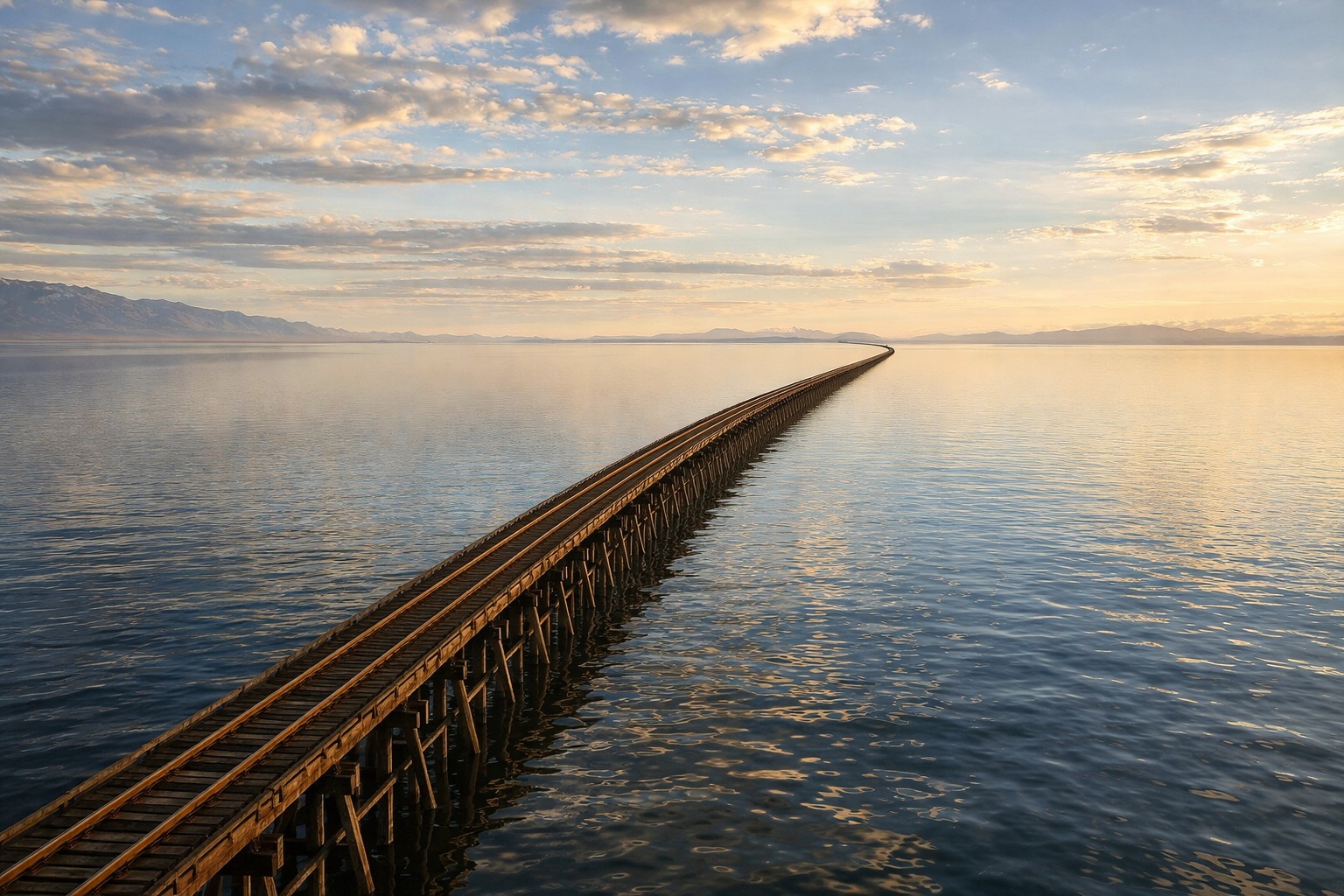
And then he turned his gaze south. In 1901, Harriman acquired control of the Southern Pacific Railroad—successor to the old Central Pacific that had driven the golden spike at Promontory Summit in 1869. His modernization of the Southern Pacific included one of the great engineering feats of the early twentieth century: the Lucin Cutoff, a 102-mile railroad line built directly across the Great Salt Lake in Utah. The project required twelve miles of trestle across open water, seventeen miles of rock fills, and nearly two years of construction. A forest of two square miles was transplanted into the lake in the form of pilings—placed end to end, they would have reached from Chicago to Buffalo. The cutoff cost $8.9 million and shortened the route by over forty-three miles, eliminating the steep, winding climb over Promontory Summit that had become a bottleneck for the increasingly heavy rail traffic of the early 1900s. It was the kind of project that only a man with Harriman's combination of vision and ruthlessness would have undertaken—speed and operational efficiency mattered more to him than immediate rate of return.
By 1901, Harriman's empire encompassed the Union Pacific, the Southern Pacific, the Central Pacific, the Pacific Mail Steamship Company, and the Wells Fargo Express Company. He controlled more miles of railroad than any man in America.
The Last of the Robber Barons
At the end of the nineteenth century, America acquired a new aristocracy: the so-called robber barons. These were industrialists and bankers who built empires through mergers, aggressive acquisitions, monopolies, and relentless competition. Their names—Rockefeller, Carnegie, Vanderbilt, Morgan—still echo through American history. Harriman would later be called "the last of the robber barons."
His weapon was neither oil nor steel. It was the railways.
He took control of troubled lines, reorganized them with surgical precision, cut costs, enforced discipline, and reinvested relentlessly. He did not hesitate to clash, pressure, and exhaust his opponents. For Harriman, the railroad was not just a means of transportation. Rails were arteries of power. Whoever controlled the rails controlled trade. And whoever controlled trade controlled the country.
Yet there was a dimension to Harriman that complicated the simple robber baron narrative. He took genuine interest in the railroads he oversaw—not merely as financial instruments, but as operational systems to be perfected. His superintendents and workers respected him for his obsessive attention to safety and efficiency. He was not merely extracting value; he was building something.
And in 1899, exhausted by the relentless pace of his work and ordered by his doctor to take a vacation, Harriman revealed another side of his character entirely.
The Alaska Expedition: A Titan at Sea
Never a man to do anything in a small way, Harriman decided to go to Alaska to hunt Kodiak bears. But rather than go alone, he conceived the idea of chartering a steamship and bringing along an elite community of scientists, artists, photographers, and naturalists to explore and document the entire Alaskan coastline.
He contacted Clinton Hart Merriam, head of the Bureau of Biological Survey at the U.S. Department of Agriculture and a co-founder of the National Geographic Society. Together, they assembled a team of twenty-five of America's leading scientists, representing geology, botany, ornithology, zoology, and paleontology. The guest list reads like a roll call of late nineteenth-century American intellectual achievement: the great naturalist John Muir, who had explored Glacier Bay two decades earlier; the photographer Edward Curtis, who would later create his monumental documentation of Native American peoples; George Bird Grinnell, editor of Forest and Stream magazine and founder of the National Audubon Society; the nature writer John Burroughs; and the paleontologist William Healy Dall.
Harriman had the 250-foot steamship George W. Elder luxuriously refitted for the voyage. The remodeled vessel featured lecture rooms, a library with over five hundred volumes on Alaska, a stable for pack animals, taxidermy studios, and well-appointed cabins. With the scientists, Harriman's family, servants, a medical team, a chaplain, hunters, guides, and the ship's crew, 126 people sailed from Seattle on May 31, 1899.
Over the next two months, the expedition traveled over 9,000 miles along the Alaskan coast, from the Inside Passage to the Bering Sea and even a short foray to Plover Bay on the Siberian coast. The scientists cataloged plants, animals, and marine life. They mapped glaciers, charted coastlines, and documented indigenous Tlingit culture using, among other instruments, a graphophonic recording machine Harriman had brought aboard. Over 5,000 photographs were taken. The expedition claimed to have discovered some 600 species new to science, including 38 new fossils. They discovered an unmapped fiord—named Harriman Fiord—and its largest glacier was christened Harriman Glacier.
At first, John Muir found Harriman distasteful and his hunting instincts barbaric. But over the course of the voyage, the naturalist and the railroad titan formed an unlikely friendship. Years later, Muir would recruit Harriman to lobby Congress on behalf of National Park legislation. And when Harriman died in 1909, it was John Muir who delivered the eulogy.
The expedition produced a fourteen-volume scientific series—the Harriman Alaska Series—financed entirely by Harriman and published by Doubleday beginning in 1901. It remains a landmark of Arctic exploration and early interdisciplinary science. In many ways, the expedition foreshadowed the collaborative, team-based approach that would define twentieth-century research, while also capturing the last gasp of a nineteenth-century ethos in which a single wealthy patron could underwrite an entire scientific enterprise.
The War for the Northern Pacific
The most explosive moment of Harriman's career came not in the wilderness of Alaska but on the floor of the New York Stock Exchange. It was May 1901, and the battle was over the Northern Pacific Railroad—a strategic prize that would determine who controlled rail access to Chicago, the vital hub connecting America's eastern and western rail networks.
The root of the conflict was the Chicago, Burlington & Quincy Railroad. Whoever controlled the Burlington controlled Chicago. Harriman wanted it for his Union Pacific. But James J. Hill—the formidable head of the Great Northern Railway, backed by the immense financial power of J.P. Morgan—got there first. Hill and Morgan used the Northern Pacific Railroad to purchase a controlling stake in the Burlington, effectively locking Harriman out.
For a man of Harriman's temperament, this meant war.
Working with Jacob Schiff at Kuhn, Loeb & Co.—and financed in part by Standard Oil money channeled through the Rockefellers' First National City Bank—Harriman launched a secret stock raid on the Northern Pacific itself. If he could seize control of the Northern Pacific, he could appoint new directors to the Burlington board and force favorable terms for the Union Pacific. Between March and early May 1901, Harriman quietly accumulated $80 million worth of Northern Pacific stock, securing a majority of the preferred shares and a near-majority of the common. He was just 40,000 common shares short of outright control.
When Hill finally suspected what was happening, he confronted Jacob Schiff in the offices of Kuhn, Loeb. Schiff admitted everything. Hill was furious—but he had a problem. Morgan was in Europe. Hill cabled frantically, and Morgan authorized the immediate purchase of 150,000 shares of Northern Pacific common at whatever price the market demanded.
What followed was not merely a bidding war. It was the first modern stock market panic.
On Monday, May 6, 1901, both sides began buying aggressively. Northern Pacific shares surged from $110 to $130 in a single day. By Tuesday's close, the two warring factions held 630,000 of the 800,000 outstanding common shares between them. Only 46,000 shares remained unaccounted for. The stock had been cornered—accidentally, through the sheer force of two opposing camps buying simultaneously.
Speculators who had sold Northern Pacific short—betting the inflated price would collapse—now realized, too late, that more shares had been sold than actually existed. The short sellers scrambled to buy stock at any price to cover their positions. Northern Pacific rocketed: $300, $500, $800, and finally $1,000 per share—all within seventeen hours of trading. It was the biggest short squeeze of the last century.
But the collateral damage was devastating. To raise cash for their Northern Pacific losses, short sellers dumped every other stock they owned. Margin loan rates spiked to 60 percent. The broader market went into freefall. Stocks like Union Pacific, Missouri Pacific, U.S. Steel, and Amalgamated Copper cratered. A rumor spread that Arthur Housman, J.P. Morgan's broker, had died—Housman had to be physically brought to the trading floor to prove he was alive and that Morgan's firm was still functioning.
The newspaper headlines captured the destruction in biblical terms: Wall Street giants, locked in a battle for supremacy, had caused a crash that brought disaster to thousands of small investors. A few titans clashed—and ordinary people were crushed beneath their feet.
By Thursday, facing the prospect of total market collapse, Morgan and Harriman called a hasty truce. The major houses agreed to stop buying Northern Pacific for their own accounts and allowed the short sellers to settle their positions at $150 per share. The panic subsided. Harriman had not won control of the Northern Pacific, but he had forced his way to the bargaining table. He secured a seat on the Northern Pacific board and extracted concessions regarding the Burlington.
The aftermath produced one of the most consequential corporate structures of the era: the Northern Securities Company, a $400 million holding company formed in November 1901 to control the Northern Pacific, the Great Northern, and the Burlington under a single umbrella. It was meant to end the warfare. Instead, it attracted the attention of a far more dangerous adversary.
Roosevelt, the Trust-Buster
President Theodore Roosevelt saw the Northern Securities Company not as a peace treaty but as a monopoly—a concentration of railroad power that threatened the public interest. In February 1902, the Department of Justice announced it would file suit under the Sherman Antitrust Act.
When J.P. Morgan traveled to Washington to settle the matter privately—as one powerful man to another—Roosevelt refused. The president later remarked that Morgan clearly regarded him as just another rival operator who could be bargained with or bought off. Roosevelt was neither.
The case went to the Supreme Court. In 1904, in a landmark five-to-four decision, Northern Securities Co. v. United States ordered the dissolution of the holding company. It was one of the earliest significant antitrust cases in American history and established crucial precedents. In the following seven years, forty-four additional federal antitrust suits drew on its logic. Among the empires eventually broken up were Harriman's own combined Union Pacific and Southern Pacific holdings.
The Northern Securities case marked a turning point not just for Harriman, but for the relationship between American government and American capital. The era in which a handful of men could reshape entire industries through private agreements in closed offices was beginning to end—though it would not go quietly.
The Shadow of 1907
Harriman's aggressive strategies and the broader culture of speculative warfare he embodied contributed to an atmosphere of systemic instability in American finance. The manipulations surrounding railroad stocks, the concentration of power in the hands of a few interconnected titans, and the absence of any central banking authority to manage liquidity crises created conditions ripe for catastrophe.
That catastrophe arrived in the Panic of 1907. Confidence in the banking system evaporated. Liquidity disappeared. Banks failed. The economy plunged into crisis. Harriman was not solely responsible—the immediate triggers involved a failed attempt to corner the copper market and a cascade of bank runs—but his name was associated with the broader pattern of extreme speculation and unchecked power that had made such panics possible.
Ironically, it was Morgan himself—the man who had opposed Harriman in the Northern Pacific battle—who was called upon to manage the crisis. In an era without a Federal Reserve, the aging banker personally coordinated the bailout, summoning New York's leading financiers to his library and refusing to let them leave until they pledged their own capital to shore up the banking system.
The Panic of 1907 demonstrated beyond any remaining doubt that the American financial system could not continue to rely on the goodwill and solvency of individual bankers to prevent collapse. Within six years, Congress would create the Federal Reserve System—a direct institutional response to the chaos that men like Harriman and Morgan had both created and, in their own ways, attempted to manage.
Reformer or Cynical Player?
Harriman's legacy remains deeply contested. On one hand, he was arguably the greatest railroad operator of his era. He took bankrupt, broken systems and transformed them into models of efficiency and profitability. He invested in infrastructure, improved safety, modernized operations, and expanded capacity. The Lucin Cutoff alone—a twelve-mile trestle across a salt lake—stands as a monument to engineering ambition. His rehabilitation of the Union Pacific was so successful that the railroad's operational standards influenced the industry for decades. He sponsored one of the most significant scientific expeditions of the nineteenth century and forged an unlikely alliance with the conservation movement through his friendship with John Muir.
On the other hand, he symbolized an era when markets could be catapulted or collapsed by the actions of a few men making decisions behind closed doors. The Northern Pacific Corner destroyed thousands of small investors. His aggressive accumulation of railroad monopolies invited—and arguably necessitated—the antitrust interventions that reshaped American corporate law. He speculated with the holdings of his own railroads, treated the stock market as a theater of corporate warfare, and operated in a world where the concept of fiduciary responsibility to small shareholders barely existed.
Was he a management genius or a ruthless speculator? A visionary who built modern infrastructure or an architect of bubbles? Perhaps, as with most of the great figures of the Gilded Age, he was all of these things simultaneously—and the tension between creation and destruction is precisely what made the era so consequential.
America on the Rails
When Edward Henry Harriman died on September 9, 1909, at his Arden estate overlooking the Ramapo River in Orange County, New York, he was sixty-one years old. Stomach cancer had claimed a man who had driven himself relentlessly for four decades. He left behind a railroad empire, a fortune estimated at between $70 and $100 million—roughly $2.3 to $3.3 billion in today's dollars—and a legacy that was already the subject of fierce debate.
At the time of his death, he controlled five railroads, the Pacific Mail Steamship Company, and the Wells Fargo Express Company. His entire estate went to his wife, Mary, and their children. The family would carry forward his philanthropic impulses: Mary donated 10,000 acres of their estate for the creation of what became Harriman State Park, today encompassing over 44,000 acres with 31 lakes and 200 miles of hiking trails, welcoming more than a million visitors annually. His son Averell would become one of the most consequential American diplomats of the twentieth century, serving as ambassador to both the Soviet Union and Great Britain, negotiating with Stalin and Churchill, and helping shape the postwar international order.
A few years after Harriman's death, the Federal Reserve was created, precisely to curb the uncontrolled panics and market manipulations that had marked the decades of the robber barons. The era he embodied was ending. The system he had both exploited and helped build was being reformed—not by men like him, but because of men like him.
He, however, had already written his name into history.
From the son of a clergyman, he became one of the most powerful men in America. From an errand boy, he became the master of an empire that stretched from the Missouri River to the Pacific Ocean and from the Great Salt Lake to the coast of Alaska. From an observer of the panic of 1869, he became the protagonist of a stock market war that sent a single share to $1,000 in a matter of hours—and shook the foundations of American finance.
In nineteenth-century America, railroads don't just lead to new cities. They lead to power. And Edward Henry Harriman understood this better than anyone who ever lived.