The Game of Spies During the Cold War
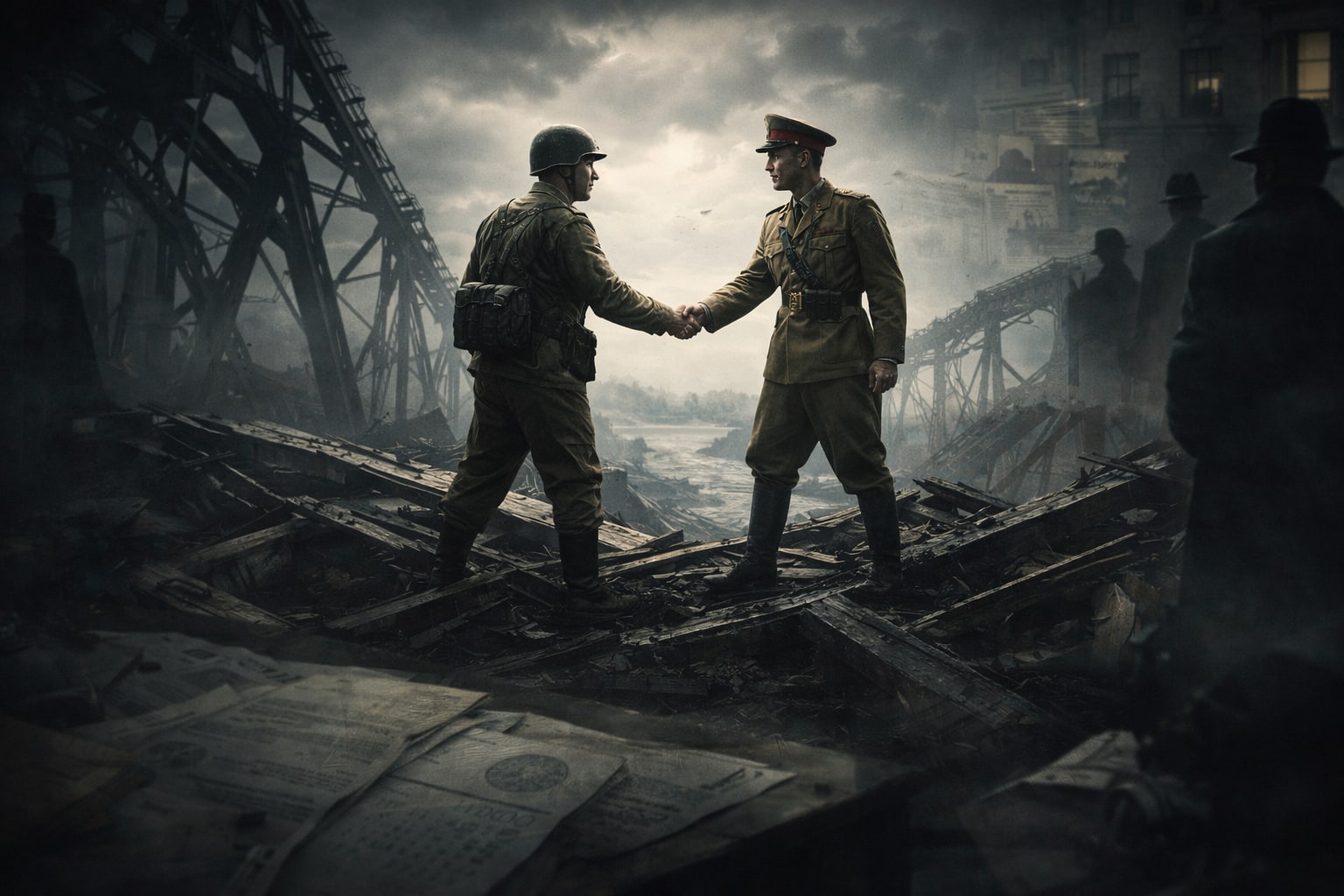
On 25 April 1945, at a broken railway bridge over the Elbe near the Saxon town of Torgau, a young American lieutenant named William Robertson held up a makeshift Stars and Stripes painted on a white bedsheet and walked out onto the twisted girders to meet a Soviet patrol led by Lieutenant Alexander Silvashko. The Soviet soldiers, never having seen an American flag, fired a warning shell, thinking it was a German trick. Minutes later, the two men embraced at the center of the wrecked span. Germany had been cut in half. Five days later Hitler killed himself in the bunker beneath the Reich Chancellery. In Moscow that night, a 324 gun salute thundered across the city. In Times Square, strangers danced.
To look at that photograph today is to see the last honest handshake between Washington and Moscow for nearly half a century. The next one would come with a hidden agenda.
The war that had just ended was the most destructive in human history, and its end was also the beginning. The old imperial order was gone. Britain was financially ruined. France had been humiliated and was about to lose its colonies. Germany and Japan lay in ruins. In the vacuum stood two powers that looked nothing like the empires they replaced and, in some respects, looked uncannily like each other.
Both were the products of revolutions that had rewritten their political charters. Both commanded vast, continental territories. Both had entered the Second World War reluctantly, dragged in by the Japanese at Pearl Harbor and the Germans at the gates of Moscow. Both emerged convinced that the world's future depended on the spread of their own system. But the resemblance ended at the constitutional threshold. One was a republic of checks, balances, and contested elections. The other was a personal dictatorship under Stalin, built on terror, famine, and the Gulag. The postwar contest between them was never really about territory. It was about what the rest of the world would look like.
That contest had a public face of summits, treaty signings, military parades, and proxy wars. It also had a face that was never meant to be seen at all. The Cold War was fought by diplomats in public and by spies in private, and in many of its most consequential episodes the spies mattered more.
The Anglo-American Compact and the Soviet Head Start
On 5 March 1946, in a top-secret ceremony in Washington, Colonel Patrick Marr Johnson of the London Signals Intelligence Board and Lieutenant General Hoyt Vandenberg of the US State Army Navy Communications Intelligence Board signed an eight page document titled the British-US Communication Intelligence Agreement. Over the following decade it would be extended to Canada in 1948 and to Australia and New Zealand by 1956, becoming the multilateral UKUSA accord and, in common speech, the Five Eyes. No signatory government officially acknowledged its existence until 2010. Australian Prime Minister Gough Whitlam was reportedly not told it existed until 1973.
By the time those five democracies got round to formalising their pact, the Soviets had already been inside the building for more than a decade.
The agents who would come to be known as the Cambridge Five were not recruited from among hardened Bolsheviks or émigré revolutionaries. They were the children of the British upper middle class: boys who had been to the best schools, who drank in the right clubs, and whose surnames opened doors at the Foreign Office without effort. The crucial figure in their recruitment was an Austrian Jewish intellectual named Arnold Deutsch, who arrived in London under academic cover at University College and began searching the Cambridge colleges for young men who were communist in sympathy but discreet enough to bury it. A second NKVD officer, the Hungarian born Teodor Maly, later assisted.
Deutsch's method was quiet and strange. He did not demand that his recruits declare for Moscow. He asked them to go silent, to abandon every visible communist affiliation, to burrow into the British establishment and wait. Kim Philby, the son of a celebrated Arabist and a Cambridge graduate with an Austrian communist wife, remembered the first meeting with something close to reverence. Deutsch, he said, looked at him as if nothing in the world mattered more than the conversation they were having. That was the moment the trap was baited.
Philby, recruited in 1934, pulled Donald Maclean and Guy Burgess in after him. Anthony Blunt, already a Cambridge fellow and several years the others' senior, was brought in through Burgess and acted as a secondary talent spotter. John Cairncross, the fifth and least grand of them, came through Blunt. Some of them had connections to the secretive Cambridge Apostles, the discussion society whose membership read like a register of the British intelligentsia.
What followed remains the most damaging single penetration of a Western intelligence service ever recorded. Between 1941 and 1945 alone, Burgess handed the Soviets 4,605 documents, Maclean 4,593, Cairncross 5,832, and Blunt 1,771. Cairncross, posted to the Bletchley Park codebreaking operation as a German translator, passed Moscow the raw Ultra decrypts that warned of the German offensive at Kursk, the battle that broke the Wehrmacht's capacity to take the initiative on the eastern front. Philby, as head of MI6's Section IX from the end of the war, was simultaneously directing British counter Soviet operations and telling the Soviets exactly who those operations were aimed at. When hopeful defectors walked into Western embassies offering to expose Soviet spies in London, Philby was the officer assigned to handle them. They never made it out.
Maclean, head of the Foreign Office's American department and posted to the Washington embassy, passed Moscow the atomic collaboration details between the United States, Britain, and Canada. Burgess, working first at the BBC and later at the Foreign Office, smuggled out Cabinet papers, nuclear policy documents, and advance warning of NATO's formation. Blunt, appointed Surveyor of the King's Pictures after the war, used his access to the royal household to retrieve sensitive documents captured from a Nazi intelligence officer and pass them east.
The unravelling began with signals intelligence. The American Army's Venona project had been quietly decrypting Soviet wartime cables since 1943. By 1951 it had narrowed the hunt for a Washington leak, codenamed Homer, down to Maclean. Philby, then working at the British embassy in Washington and therefore reading the same cables, knew the net was closing. He dispatched Burgess, who was being recalled for bad behaviour after three speeding tickets in a single day, to warn Maclean in London. On 25 May 1951, Burgess and Maclean boarded a ferry at Southampton and vanished. They surfaced in Moscow only in 1956.
Philby was immediately suspected, but there was no hard evidence. He was forced out of MI6, drifted to Beirut to work as a correspondent for The Observer and The Economist, and kept feeding Moscow for another twelve years. When Soviet defector Anatoliy Golitsyn finally provided enough to nail him in 1962, he fled to the Soviet Union aboard a freighter in January 1963. He died in Moscow in 1988, a colonel in the KGB, and was given a military funeral. Burgess preceded him, dying of acute liver failure and arteriosclerosis in 1963. Maclean lasted until 1983. Blunt, extraordinarily, had confessed to MI5 in 1964 in exchange for immunity and kept his post as Surveyor of the Queen's Pictures, his knighthood, and his Cambridge chair until Margaret Thatcher named him in Parliament in 1979. Cairncross confessed the same year as Blunt and was not publicly exposed until 1990.
In 2019, the Russian Foreign Intelligence Service installed a plaque on the Moscow building where Burgess and Maclean had lived. Its director praised the pair for having, as he put it, made a significant contribution to the protection of Russian strategic interests. It was the closest thing to an official epitaph the Cambridge ring would receive.
The Norwegian Fault Line and the Man Who Walked Out of Moscow
It is tempting to imagine that the spy drama of the Cold War was confined to London, Washington, Berlin, and Vienna. The deepest wounds were often inflicted on the smaller fronts.
Arne Treholt was the son of a Labour Party minister, a graduate of Oslo's diplomatic bench, and for a period in the 1970s, one of the rising stars of the Norwegian foreign policy establishment. He served as political secretary to Commerce Minister Jens Evensen, became Norway's counselor at the United Nations in New York, and in 1983 was appointed head of the press department at the Ministry of Foreign Affairs. On 20 January 1984, as he walked through the departure gate at Oslo's Fornebu Airport with an attaché case of classified documents bound for a meeting in Vienna with KGB General Gennadij Titov, he was arrested by Ørnulf Tofte, the head of Norwegian counterintelligence.
The trial ran through 71 witnesses and 20,000 documents. Treholt was convicted of passing classified material to the KGB from 1974 to 1983 and to the Iraqi Intelligence Service from 1981 to 1983. His 20 year sentence was one year short of the Norwegian maximum. The material he had handed over reportedly included Norwegian mobilization plans, NATO storage locations inside the country, details of the Norwegian Joint Staff College and memoranda written for the Prime Minister. Letters from the KGB archive later revealed that Moscow had offered to exchange 22 Western spies in its custody for Treholt in 1988. The Norwegians refused.
When the Labour government of Gro Harlem Brundtland pardoned him in 1992 for health reasons after eight and a half years served, the country erupted. His second wife, whom he had married in prison, had died of a drug overdose months earlier. His defenders argued the evidence against him had been mishandled. His critics saw something worse: a political class looking after one of its own.
The policeman who had arrested him, Ørnulf Tofte, became something of a legend in Scandinavian counterintelligence. Before Treholt, he had brought down the Soviet agents Asbjørn Sunde and Gunvor Galtung Haavik. Tofte dismantled the entire Soviet penetration of Norway. Treholt himself spent his later years in Moscow and Cyprus, running businesses with former KGB contacts and, after Russia's 2022 invasion of Ukraine, writing articles arguing that Moscow's security concerns were legitimate and that Russia was being unfairly demonized. He died in Moscow in February 2023, at 80, still insisting he had only been trying to keep open channels of dialogue between East and West.
The name that first put the Norwegians on his trail had come from London. More precisely, it had come from a KGB colonel named Oleg Gordievsky.
Gordievsky was the son of an NKVD officer and the brother of another. He joined the KGB's illegals directorate in 1962, learned Danish, Swedish, Norwegian, English and German, and was posted to Copenhagen in 1966. The Prague Spring of 1968, and the Soviet tanks that crushed it, broke whatever faith in the system he had left. By 1974 he was passing material to MI6 under the codename SUNBEAM, later NOCTON. The CIA, which had been told only that the British had a high level source inside Soviet intelligence, gave him its own codename: TICKLE.
What made Gordievsky uniquely valuable was not just the volume of what he produced but the career trajectory British intelligence engineered around him. MI6 fed him enough non damaging material to make him look brilliant to his own superiors and worked quietly to arrange the recall of his direct bosses back to Moscow on pretexts, clearing his path upward. By April 1985 he had been designated resident, the head of the KGB station in London.
Then, in May, he was abruptly summoned to Moscow. On arrival he was drugged with truth serum laced brandy and interrogated by a KGB general for five hours. He gave nothing away, but he understood. The net was closing. In his own later words, he had to break out of the great concentration camp of the Soviet Union within weeks or die.
The escape plan had been drafted years earlier by an MI6 officer named Valerie Pettit and was called Operation Pimlico. Its trigger was absurd in its ordinariness. Gordievsky was to stand at a specified Moscow street corner at 7pm on a Tuesday, holding a Safeway bag. An MI6 officer would walk past carrying a Harrods bag and eating a Mars bar. Eye contact would activate the plan.
On the second Tuesday he tried, the Mars bar appeared. On 19 July 1985, Gordievsky went out for his usual morning jog, slipped KGB surveillance, caught a train to Leningrad, then a local service to Zelenogorsk, and then a bus toward the Finnish border. A pair of British diplomatic cars, driven by MI6 officers with their wives and, in one case, a newborn baby as cover, collected him at a lay by and hid him in a specially modified compartment in the boot. At the Finnish border, Soviet customs guards brought dogs around the vehicles. One of the wives distracted the Alsatians with potato chips and a dirty nappy. The cars were waved through. When the driver turned up the radio and Sibelius's Finlandia came through the speakers, Gordievsky knew he was alive.
He had been betrayed by Aldrich Ames.
Parallel Lives
It is hard to imagine two men more different than Oleg Gordievsky and the CIA officer who sold him out. One was a cultured, Shakespeare reading son of Soviet intelligence aristocracy who loved Western opera and grew to despise the system he had been born into. The other was a career mediocrity from Wisconsin whose CIA evaluations noted his drinking problem and whose Christmas parties at Langley tended to end with him being driven home by the Office of Security.
Aldrich Ames had been with the agency since 1962. By the early 1980s he had landed, more by attrition than by merit, in the counterintelligence branch responsible for Soviet operations: the exact chair in which a man could read the names of every CIA source inside the USSR. His first marriage had collapsed expensively. He had met a young Colombian embassy employee named Maria del Rosario Casas in Mexico City, fallen for her, and wanted a life he could not afford. On 16 April 1985 he walked into the Soviet embassy in Washington and offered his services. On 13 June of that year, according to his own account, he met a Soviet contact at Chadwicks restaurant in Georgetown and handed over several pounds of documents identifying the CIA's Soviet assets.
The consequences were catastrophic. Ames compromised, in his own courtroom admission, virtually every Soviet agent the CIA was running. At least ten of them were executed. Among the dead were Major General Dmitri Polyakov of the GRU, who had spied for the United States since the early 1960s and had refused all offers of money, insisting he served for his own reasons. Polyakov was executed in 1988. Colonel Leonid Poleshchuk, a counterintelligence officer, was arrested in Nigeria and shot. Major Sergei Motorin of the Washington rezidentura was executed in 1988. Lieutenant Colonel Valery Martynov, another of the Washington pair, was shot in 1987. Gordievsky would almost certainly have been added to this list had Operation Pimlico not pulled him out.
Ames was paid more than $2.7 million over nine years, the largest sum Moscow ever paid an American spy. He spent it conspicuously: a half million dollar house in Arlington paid for in cash, a Jaguar, and his wife's credit card bills. A CIA analyst named Sandy Grimes and an FBI officer named Jeanne Vertefeuille, working in a small mole hunting unit the agency had quietly set up in 1986 after its Soviet network began to collapse at an alarming rate, eventually correlated Ames's bank deposits with his meetings with Soviet embassy officials. He was arrested outside his Arlington home on 21 February 1994. He pleaded guilty and received life without parole. His wife got 63 months for tax evasion and conspiracy. He died in a Maryland federal prison in January 2026, aged 84, having spent his last three decades insisting that what he had done was a sideshow that had not really damaged American security.
Gordievsky outlived him by almost a year. He died in March 2025 in the quiet English village where MI6 had settled him in 1985, under a name I will not print. He had been made a Companion of the Order of St. Michael and St. George by the Queen in 2007. The Soviet Union had sentenced him to death in absentia, and Russia never rescinded the sentence.
Ames never expressed ideological conviction of any kind. He did it, as he told a reporter the day before he was sentenced, for financial troubles, immediate and continuing. Gordievsky, by contrast, had watched Soviet tanks roll into Prague in 1968 and concluded that the system he served was a lie. Sit with that for a moment. The man who betrayed his country for a wife and a Jaguar will be remembered as one of the most damaging moles in CIA history. The man who betrayed his country because he believed it had betrayed itself is remembered, at least in the West, as a hero. Whether history records either verdict correctly is a question the archives have not yet fully answered.
What the archives do make clear is that by the 1980s the intelligence war had become something quite different from the ideological contest of the 1930s. Philby and his friends sold their country out of conviction, however warped. Ames sold it out of consumer debt. Somewhere between those two men lies the real story of how the Cold War ended and of why the institutions that fought it are still struggling, forty years later, to tell a clean story about who won and who lost.
The Soviet Union collapsed in 1991. The Five Eyes still meet. Russian intelligence services still run operations inside Western capitals, and Western services still run them inside Russian ones. The Elbe handshake is now a bronze plaque at Arlington and a stone marker at Torgau. The spies who followed it wrote a different history, most of it in files that are still classified, and the parts that have come out read less like a morality play than like a long, grey study in how much damage one well placed human being can do from inside a locked room.