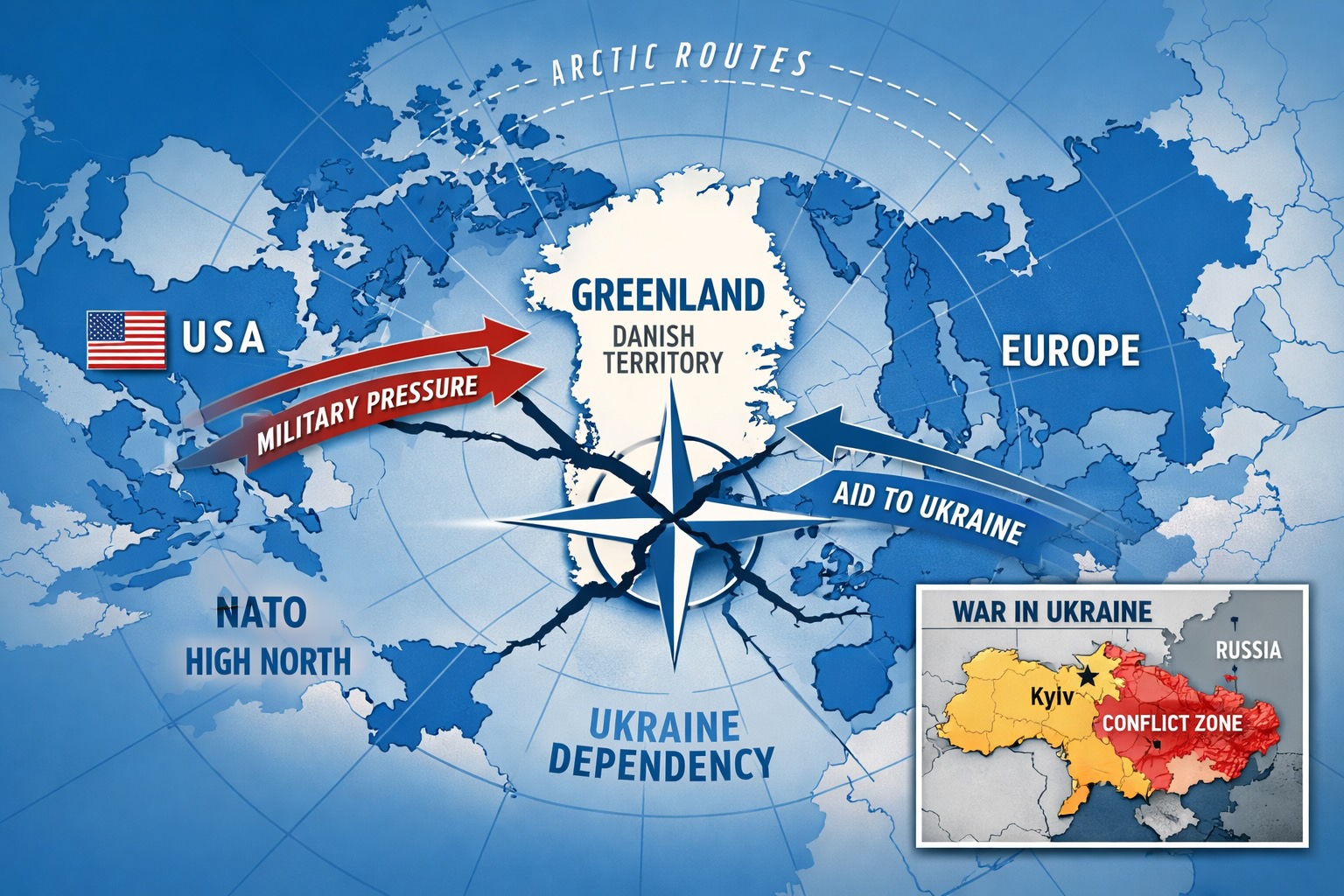
Trump's Greenland Threat Exposes NATO's Crisis: Europe Caught Between Arctic Ambitions and Ukraine
From Greenland to Ukraine, Europe's Trapped Between Trump's Realpolitik Millstones
Confronted by Washington's aggressive revisionism and the deepening fractures within NATO over Arctic sovereignty and Russian aggression, Europe finds itself perpetually reacting rather than leading—a strategic posture that may prove fatal to its interests.
The Inescapable Contradiction
A profound contradiction now haunts the corridors of power in Brussels, Berlin, Paris, and Copenhagen: How can Europe reconcile its desperate need for American support in Ukraine with Washington's direct assault on the sovereignty of Denmark—a founding member of both NATO and the European Union?
This is not a hypothetical dilemma for academic debate. It is the central strategic question facing European leaders as the Trump administration transforms transatlantic relations into a crude exercise of coercive power, positioning allied Europe not as a partner but as a potential obstacle to American ambitions.
For Trump, Greenland represents neither a Danish possession nor an autonomous territory within the Kingdom of Denmark. It is a strategic prize—a frozen trophy in the intensifying great-power competition for Arctic dominance and control of the Western Hemisphere. National security imperatives, the island's commanding strategic position, vast deposits of rare earth minerals, emerging polar shipping routes, and the perceived necessity of denying China a foothold in the region have coalesced into a rationale that, in the president's calculus, legitimizes annexation—whether through purchase, political pressure, or military intervention.
This worldview finds formal expression in the administration's revised National Security Strategy, which reads as a twenty-first-century iteration of the Monroe Doctrine, updated for an era of great-power competition and stripped of any pretense toward multilateral consultation.
Venezuela: The Dress Rehearsal
The recent abduction and arrest of Nicolás Maduro in Venezuela provided a stark preview of this doctrine in action. Europe's response—fragmented, contradictory, and ultimately impotent—revealed the depth of the continent's strategic paralysis when confronted with American unilateralism.
Yet beyond exposing European disunity, this lightning operation carried a message of broader significance. By violating established norms of international law and revealing the nakedly hegemonic and economic motivations driving American policy, the White House articulated a new paradigm for global order: The world is governed by power, not rules. Sovereignty is conditional, contingent on the tolerance of the strong.
This logic applies with equal force to Greenland, to Ukraine, and to Europe itself.
The Architecture of Dependence
For seven decades, European security has rested upon American foundations. The war in Ukraine has illuminated this dependency with uncomfortable clarity. Despite years of rhetoric about strategic autonomy and European defense initiatives, no capital on the continent can credibly deny that without American military assistance, logistical support, and intelligence sharing, Ukraine's resistance would have collapsed or been reduced to a fraction of its current effectiveness.
More troubling still: any meaningful post-war security architecture for Ukraine—the guarantees that might deter future Russian aggression—would be hollow without American participation. European powers lack both the military capacity and the political cohesion to underwrite such commitments independently.
It is precisely this structural dependence that places Europe in an impossible position. When your security guarantor becomes a potential threat to your allies, the entire strategic calculus fragments.
European leaders have responded to Trump's Greenland threats with statements affirming respect for international law and expressing solidarity with Copenhagen. These declarations are juridically correct. They are also strategically meaningless. Notably absent from any European pronouncement is an answer to the question that actually matters: What happens if the American president simply ignores them?
Playing Catch-Up in the Arctic
Trump's designs on Greenland are not new. He has threatened annexation repeatedly since returning to the White House, yet for months the Alliance treated these pronouncements as rhetorical excess—the bombast of a president who governs through provocation. Copenhagen believed it had successfully managed American demands through quiet diplomacy.
That assessment now appears catastrophically wrong.
European forces—Danish troops reinforced by NATO allies—are being rushed to Greenland under the thin cover of "exercises" designed to demonstrate resolve and bolster the island's security posture. France has announced the opening of a consulate, a diplomatic marker of European interest. Copenhagen has reminded Washington, with increasing desperation, that existing defense agreements already provide the United States with extensive access to Greenland's territory and facilities.
None of this appears to be softening the American position. If anything, European resistance seems to have hardened Washington's determination.
NATO's Existential Question
Greenland has thus become a stress test for the Atlantic Alliance, forcing an existential question that member states have studiously avoided: Can NATO survive in its current form when its most powerful member treats the alliance's foundational principles as optional?
The absurdity of the situation defies easy comprehension. Seven of the eight Arctic nations are NATO members. Greenland is already covered by Article 5—the collective defense guarantee that constitutes the alliance's core commitment. Yet Trump insists that Greenland must be controlled directly by the United States, the only power capable, in his telling, of defending the island against Chinese and Russian encroachment and thus securing NATO's northern flank.
The circular logic is breathtaking: America must control Greenland to protect NATO, even if doing so requires violating the sovereignty of a NATO member and undermining the principles upon which the alliance was built.
Recent statements from senior administration officials have dispensed with diplomatic ambiguity entirely. The assertion that "no one will fight the United States over Greenland" encapsulates a cynical but perhaps accurate assessment: American power has reached a threshold where consensus becomes unnecessary. Washington demands compliance. And Washington believes it can act as it pleases.
Ukraine and Greenland: The Same Battle
The implications for Ukraine are immediate and severe.
European strategy for the post-war period—to the extent such strategy exists—rests on the assumption that the United States will remain a reliable security guarantor, providing the deterrent backbone that European forces cannot supply independently. But how stable can such guarantees be when the guarantor treats international commitments as negotiable, geopolitics as transactional, and allied sovereignty as contingent?
In this light, Ukraine and Greenland cease to be separate crises. They are manifestations of the same underlying challenge: Europe's confrontation with a world order in which great powers—including its ostensible ally—impose their will through strength rather than law.
For the European Union in particular, perpetually divided and institutionally cumbersome, these twin crises pose a fundamental question of identity. Will Europe emerge as a consequential actor in a legitimate multipolar system, capable of defending its interests and values? Or will it accept the role of spectator in a world where the strong do what they can and the weak suffer what they must?
The Vanishing Order
The post-1945 international order—the system of rules, institutions, and norms that Europeans believed would constrain great-power behavior indefinitely—is receding with alarming speed. The assumptions that guided European foreign policy for generations are being invalidated in real time.
What makes this moment particularly dangerous is the pace of transformation. Events are moving faster than European institutions can adapt. By the time Brussels reaches consensus on a response to one crisis, three more have emerged. The deliberative processes that Europeans prize as democratic virtues have become strategic liabilities.
There is no longer room for the comfortable illusion that the old order will somehow reassert itself, that Trump represents an aberration after which normalcy will return, or that time is on Europe's side.
The millstones are grinding. Europe remains caught between them. And the window for meaningful action grows narrower by the day.
The question is no longer whether Europe will be forced to choose between its principles and its security. That choice has already arrived. The question is whether European leaders will recognize it before events render their deliberations irrelevant.