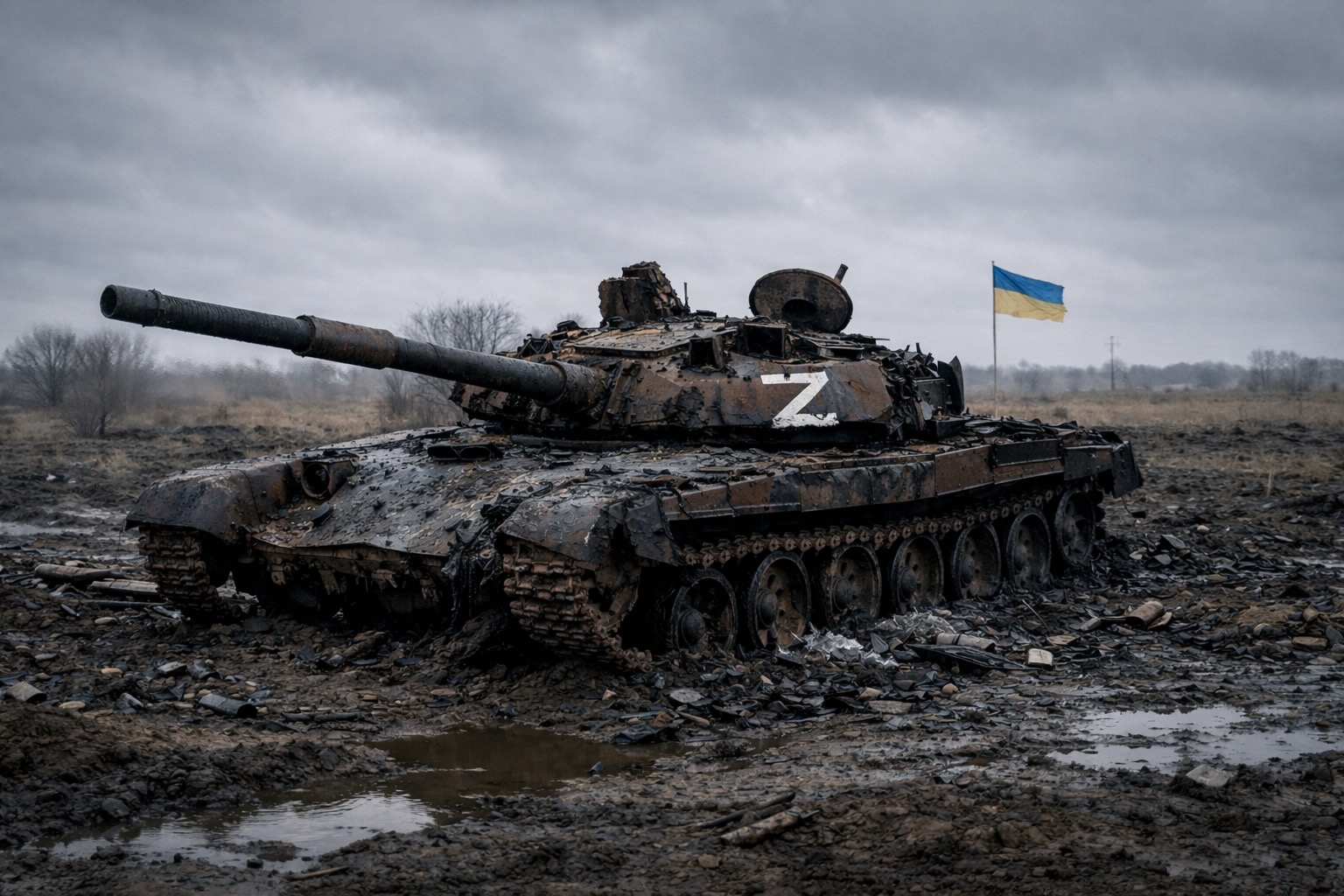
Russia's Four Year Failure in Ukraine: Military, Strategic and Economic Collapse Explained (2026)
On February 24, 2022, Russian armored columns rolled across the Ukrainian border in what the Kremlin euphemistically called a "special military operation." Vladimir Putin expected a swift decapitation of the Ukrainian government, a collapse of national resistance, and the installation of a puppet regime in Kyiv within days. Four years later, none of those objectives have been achieved. What was supposed to be a lightning conquest has become the deadliest European conflict since the Second World War, a ruinous quagmire that has hollowed out the Russian military, shattered the country's economic trajectory, and achieved the opposite of nearly every strategic goal the Kremlin set out to accomplish. As the war enters its fifth year, the evidence is overwhelming: Russia's invasion of Ukraine has been a catastrophic failure on virtually every front that matters.
I. The Military Failure: A Meat Grinder With No Victory in Sight
The Collapse of the Opening Campaign
The full scale invasion began with the most ambitious Russian military operation since the Soviet invasion of Afghanistan. Columns of tanks and airborne troops advanced on Kyiv from the north, while simultaneous offensives struck from the east, south, and through Crimea. The plan assumed that Ukrainian resistance would crumble, the government of Volodymyr Zelensky would flee, and Russian forces would seize the capital within 72 hours.
Instead, the Russian advance on Kyiv became a legendary debacle. Poorly coordinated logistics left armored vehicles stranded without fuel on highways north of the capital. Ukrainian forces ambushed supply convoys, destroyed command vehicles, and used Western supplied anti tank missiles to devastating effect. The famed 40 mile Russian convoy that clogged the roads leading to Kyiv became a symbol not of overwhelming power but of staggering incompetence. By April 2022, Russia was forced into a humiliating withdrawal from the entire Kyiv axis, abandoning equipment, bodies, and the pretense that this would be a quick war.
The retreat from Kyiv was not merely a tactical setback. It was the death of the original war plan. From that moment forward, Russia was fighting a fundamentally different and far more costly war than the one it had planned for.
The Attritional Nightmare
After retreating from northern Ukraine, Moscow refocused its efforts on the Donbas region and the southern front. The war transformed into a grinding attritional struggle resembling the trench warfare of the First World War more than any modern conflict. Russian forces adopted a doctrine centered on massed artillery bombardment followed by infantry assaults, often using poorly trained conscripts and convicts recruited from Russian prisons.
The results have been staggering in their human cost and modest in their territorial gains. According to the Center for Strategic and International Studies (CSIS), combined Russian and Ukrainian casualties may have reached 1.8 million by early 2026 and could surpass 2 million by spring. On the Russian side alone, an estimated 1.2 million troops have been killed, wounded, or gone missing since the invasion began. Of those, approximately 325,000 are believed to have been killed. These numbers are almost incomprehensible. Russia's total losses in four years of fighting in Ukraine now dwarf the combined casualties of every Russian and Soviet conflict since the end of the Second World War.
The rate of attrition has only accelerated. In the first 47 days of 2026 alone, Russian losses surpassed 50,000. Ukrainian sources indicate that in December 2025 and January 2026, Russia lost approximately 35,000 and 30,000 troops respectively. By early 2026, according to Bloomberg, the Russian army was losing 9,000 more soldiers per month than it could recruit through volunteer enlistment. The British Defence Secretary confirmed that this trend had persisted for at least two months: the Russian military is burning through manpower faster than it can replace it.
Ukraine's stated goal is to push Russian monthly losses to between 50,000 and 60,000 troops. If achieved, military analysts assess that even a general mobilization in Russia would be insufficient to replenish the ranks. The 300,000 troops mobilized in the autumn of 2022 have, according to Ukrainian intelligence, all been killed or incapacitated.
Territorial Gains at an Extraordinary Price
Four years into the war, Russia controls approximately 20% of Ukraine's territory, including Crimea and parts of Donbas it seized before the full scale invasion. The territory gained since February 2022 amounts to roughly 29,000 square miles, an area approximately the size of half the state of Illinois.
But the rate of advance tells a damning story. Russian forces have been on the offensive since roughly January 2024, yet progress has been agonizingly slow. The advance toward Pokrovsk, a key logistics hub in Donetsk, covered just under 50 kilometers in nearly two years, averaging about 70 meters per day. In 2025, Russian forces gained an average of 171 square miles per month. For context, at that rate, it would take Russia decades to conquer even the remainder of the Donetsk region, let alone all of Ukraine.
The cost per kilometer is staggering. Russia has been losing an estimated 100 to 150 troops for every square kilometer of Ukrainian territory gained. President Zelensky noted that across the 1,200 kilometer front line, Russia is losing more than 170 soldiers per kilometer. These are not the metrics of a successful military campaign. They are the metrics of a catastrophe being sustained through sheer disregard for human life.
Equipment Losses and Industrial Strain
Russia's material losses have been equally devastating. By early 2026, Russian forces had lost over 24,000 pieces of major military equipment, including nearly 14,000 tanks and armored vehicles, over 700 aircraft and helicopters, and 29 naval vessels. The Black Sea Fleet, once the pride of Russian naval power in the region, has been crippled by Ukrainian strikes using domestically produced naval drones and Western supplied anti ship missiles, forcing much of what remains to relocate away from Crimean ports.
While Russia's defense industrial base has ramped up production with assistance from China, Iran, and North Korea, the quality and sophistication of replacement equipment has declined. The modern T 90 tanks and precision guided munitions that Russia deployed in the opening months of the war have increasingly been replaced by refurbished Soviet era T 62s and unguided munitions. The defense industrial base faces its own constraints: chronic labor shortages, difficulty sourcing Western microchips and precision components due to sanctions, and the sheer volume of equipment being destroyed on the front lines.
The Failure of Combined Arms Warfare
Perhaps the most damning military indictment of Russia's performance is its persistent inability to conduct effective combined arms operations. Modern warfare depends on the coordinated use of infantry, armor, artillery, air power, electronic warfare, and logistics in a synchronized manner. The Russian military's failure to achieve this coordination has been one of the most surprising revelations of the war.
Russian ground assaults have frequently been conducted in piecemeal fashion, with small squads of infantry advancing without adequate air cover, artillery preparation, or logistical support. Communication failures between units have been rampant. Officers have been killed in disproportionate numbers due to poor operational security, including the use of unsecured mobile phones. Morale problems, corruption in the supply chain, and inadequate training for newly mobilized soldiers have compounded these failures.
The result is a military that relies overwhelmingly on mass and attrition rather than skill and maneuver. Russia's approach to the war increasingly resembles the "meat assault" tactics of the Soviet era, sending waves of poorly equipped soldiers forward to absorb Ukrainian fire and identify defensive positions, followed by artillery and glide bomb strikes. It is effective in grinding down defenders, but only at an astronomical cost in lives and equipment.
II. The Strategic Failure: Achieving the Opposite of Every Goal
NATO: Stronger, Larger, and More United
If Russia's primary strategic rationale for invading Ukraine was to halt NATO expansion and push the alliance back from its borders, the war has produced the exact opposite result. Before the invasion, NATO was widely viewed as a divided and directionless alliance, with member states questioning its relevance and spending far below agreed targets. Putin's invasion changed all of that virtually overnight.
Finland, which shares an 830 mile border with Russia and had maintained a policy of military neutrality for decades, joined NATO in April 2023. Sweden followed in March 2024. These two accessions more than doubled the length of NATO's direct border with Russia and brought two of Europe's most capable militaries into the alliance. This was precisely the outcome Russia claimed it was invading Ukraine to prevent.
Beyond expansion, the war has triggered a massive rearmament across Europe. Germany announced a 100 billion euro special defense fund within days of the invasion and has since committed to permanently raising defense spending above 2% of GDP. Poland has emerged as one of the most militarily ambitious nations in Europe, aiming for defense spending of 4% or more of GDP. NATO members collectively have pledged under the Hague framework to raise spending toward 5% of GDP, a target that would have been unthinkable before 2022.
The alliance is more unified, more heavily armed, and more explicitly focused on deterring Russia than at any point since the Cold War. Even the Royal United Services Institute (RUSI), in a February 2026 analysis, concluded bluntly that since retreating from Kyiv in 2022, Russia has failed in four of its five strategic objectives: political subjugation, economic sustainability, regime stability, and international standing. Only in territorial control does it hold what amounts to a pyrrhic advantage.
Ukraine: More Western, Not Less
The invasion was supposed to pull Ukraine permanently back into Russia's sphere of influence. Instead, it has pushed Ukraine further toward Europe and the West than at any previous point in its history. Ukraine was granted EU candidate status in June 2022 and has since accelerated its integration with European institutions. European nations are supplying weapons, training Ukrainian troops, investing in Ukrainian defense industries, and providing tens of billions of euros in financial assistance. A recent EU loan arrangement of 90 billion euros effectively finances the Ukrainian state through 2027.
Ukraine now possesses the most experienced and battle tested military in Europe, a force that has demonstrated its ability to defend against a much larger adversary while innovating with drones, electronic warfare, and asymmetric tactics that are being studied by militaries around the world. Regardless of how the war ends, Ukraine's military, political, and economic alignment with Europe is now deeply entrenched. Even a peace agreement that formally bars Ukraine from NATO membership would not change the practical reality that Ukraine is functionally aligned with the Western security architecture.
This represents a total strategic failure for Russia. The stated goal of keeping Ukraine within Moscow's orbit has not only failed; the invasion has ensured that Ukraine's Western orientation will endure for generations.
The Erosion of Russian Influence
Beyond Ukraine and NATO, Russia's broader geopolitical standing has deteriorated significantly. The invasion prompted an unprecedented wave of Western sanctions and resulted in the freezing of approximately $300 billion in Russian central bank reserves held abroad. Russia has been severed from major international financial systems, including SWIFT, and has lost access to Western technology, capital markets, and investment.
Russia's international relationships have narrowed. While Moscow has deepened ties with China, Iran, and North Korea, this is less a sign of geopolitical strength than of desperation. Russia's dependency on China has grown enormously, giving Beijing significant leverage over Moscow. Iran and North Korea have supplied drones and artillery shells, but these partnerships carry their own costs and do not compensate for the loss of economic integration with Europe, which was Russia's largest trading partner before the war.
In the Global South, Russia's influence is more ambiguous than the Kremlin would like to admit. While some nations have maintained economic ties with Moscow, few have actively endorsed the invasion, and Russia's image as a reliable partner has been damaged by its weaponization of food and energy supplies.
The Domestic Trap
Perhaps the most dangerous strategic failure is the one Russia has inflicted upon itself domestically. The war has become foundational to the regime's political legitimacy. The Russian economy has been restructured around wartime production. The Kremlin's ability to maintain domestic support depends on delivering the war's stated objectives, or at least maintaining the appearance of progress.
This creates what RUSI analysts describe as a psychological trap. Putin cannot accept any peace deal that could be perceived as anything other than complete victory without risking the delegitimization of his entire regime. The authoritarian model that justified itself by promising to restore Russian greatness cannot acknowledge strategic defeat without inviting political collapse. Escalation therefore becomes not a choice but a structural necessity, even as the resources available to sustain escalation are dwindling.
Reports of growing social strain within Russia are mounting. An estimated 250,000 unemployed veterans of the "special military operation" have returned to civilian life, and Russian state media reportedly scrubbed the story almost immediately after publication to avoid public anxiety. Crime, domestic instability, and substance abuse among returning veterans are expected to rise, echoing and likely exceeding the social damage caused by the Soviet war in Afghanistan. Russia's labor minister has reportedly told Putin that the country faces a shortage of 2.4 million workers by 2030, a gap being deepened by the massive diversion of working age men into the military.
III. The Financial Failure: A War Economy Eating Itself
The Illusion of Resilience
When Western sanctions were first imposed in early 2022, many predicted a swift collapse of the Russian economy. That collapse did not materialize. After an initial contraction of about 1.4% in 2022, the economy rebounded with growth of over 4% in both 2023 and 2024. Proponents of the Kremlin's narrative pointed to these figures as proof of sanctions' failure and Russia's economic resilience.
But this narrative was always misleading. The growth was driven primarily by a massive surge in military spending, what economists describe as military Keynesianism. The government poured hundreds of billions into defense production, driving up demand, employment, and output in weapons manufacturing and related sectors. This is the economic equivalent of a sugar rush: it produces impressive headline numbers while masking structural deterioration underneath.
The bill is now coming due.
Stagnation and Contraction
Russia's economic growth collapsed in 2025. After two years of wartime expansion, GDP growth slowed to approximately 0.6 to 1%, depending on the estimate. The International Monetary Fund projects growth of just 0.8% in 2026. Manufacturing declined at its fastest rate since March 2022, with seven consecutive months of contraction in 2025 and production levels falling for ten straight months. Consumer demand weakened, investment dried up, and the civilian economy effectively stagnated while military spending continued to consume an ever larger share of national resources.
Russia enters 2026 with what analysts describe as growth exhaustion. The temporary drivers that sustained the wartime boom, the rebound from the 2022 shock, the one time shift of resources into military production, the initial fiscal stimulus, have all been spent. What remains is an economy that is structurally damaged, sanctions constrained, and increasingly dependent on a single sector: the military industrial complex.
The Budget Crisis
Russia's fiscal position has deteriorated sharply. Military spending now consumes roughly half of the entire federal budget. The war costs an estimated 250 billion euros per year. Even as spending has surged, revenues have fallen. Oil and gas income, which historically accounted for over 40% of Russian government revenue, dropped by approximately 24% in 2025, to around $111 billion. The fall reflects both lower global oil prices and the tightening grip of Western sanctions on Russia's energy exports.
For the first time since the pandemic, Russia collected less budget revenue in 2025 than originally planned. The government had projected revenues of 40.3 trillion rubles; actual receipts came in closer to 36.6 trillion rubles, a shortfall of nearly $50 billion. The budget deficit, which the government had hoped to keep below 1% of GDP, has repeatedly exceeded expectations and is now projected at 1.6% of GDP for 2026, with officials quietly acknowledging it may go higher.
The National Wealth Fund, Russia's sovereign reserve designed to buffer against economic shocks, has been rapidly depleted. Its liquid assets plummeted from a prewar peak of $113.5 billion to approximately $36 billion by mid 2025. Russian economists have warned that the fund could run dry by 2026. At the same time, Russia's access to freely convertible currency has collapsed. The freezing of roughly $300 billion in foreign reserves reduced Russia's available hard currency reserves by a factor of seven, from $610 billion at the start of the war to roughly $86 billion by early 2025. While Russia has accumulated gold reserves, sanctions prevent easy conversion into usable currency.
Domestic borrowing has become increasingly expensive and inflationary. The central bank raised its key interest rate to 21% in 2024, the highest in years, before beginning a cautious cutting cycle that brought it down to 16% by early 2026. Even at 16%, the cost of credit is punishing for private sector investment. Yields on ten year government bonds exceed 15%, making government borrowing extraordinarily expensive. Most funds raised through bond issuance are consumed by servicing and repaying existing debt. Debt servicing costs, which represented just 0.9% of GDP in 2021, are projected to reach nearly 2% of GDP in 2026, consuming approximately 9% of total federal spending.
Inflation and the Squeeze on Ordinary Russians
While headline inflation fell to approximately 6% in late 2025, the official figures are widely regarded as understating the true picture. Food prices rose by 21% in early 2026, services by 14%, and fuel prices climbed 11% following Ukrainian strikes on Russian refineries. The central bank's extraordinarily tight monetary policy, with real interest rates well above 10%, suggests that actual inflation has consistently exceeded official figures.
To cover the budget gap, the government has resorted to aggressive tax increases. The VAT rate was raised from 20% to 22% effective January 2026. More businesses are being pulled into the tax net, and the government is introducing new levies on electronic goods. These measures transfer the cost of the war directly onto Russian consumers and businesses, further depressing domestic demand and civilian investment.
The labor market tells its own story of strain. Unemployment sits at approximately 2%, a figure that might seem positive in normal times but in Russia's context reflects not economic health but a severe labor shortage caused by the diversion of hundreds of thousands of working age men into the military. Businesses must pay higher wages to attract increasingly scarce workers, which drives up costs and feeds inflation in a vicious cycle. Russia's labor minister has acknowledged a projected shortfall of 2.4 million workers by 2030, and some estimates are higher.
Oil Revenue Under Pressure
Russia's economic model has long depended on hydrocarbon exports. The war has placed that lifeline under growing pressure. Global oil prices have been on a downward trend, with the World Bank expecting Brent crude to fall to around $60 per barrel in 2026, the lowest level in five years. But Russia's problem is worse than falling global prices alone. Western sanctions, including the price cap mechanism, maritime insurance restrictions, and enforcement actions against Russia's "shadow fleet" of tankers, have forced Russia to sell its crude at steep discounts.
By late 2025, Russian export oil was trading at around $50 per barrel, well below the $60 baseline assumed in the budget. India, which had become one of Russia's largest oil customers after European buyers withdrew, has begun reducing its purchases. India's share of Russian oil imports fell from 40% in 2024 to 25% by early 2026, partly under pressure from a trade deal with the United States. If this trend continues, it would represent another significant blow to Russia's revenue base.
Oil production tax revenues hit their lowest level since January 2023, dropping 34% year over year. The combination of lower prices, steeper discounts, and reduced volumes is creating a structural squeeze that Russia cannot easily escape.
The Long Term Damage
Beyond the immediate fiscal crisis, the war is inflicting lasting damage on Russia's economic potential. Foreign investment has essentially ceased. Russia cannot borrow on international markets. Multinational companies that once operated in Russia have withdrawn. The brain drain that began in 2022, when an estimated one million Russians left the country, has continued to deplete the workforce of its most educated and skilled members.
A war economy diverts resources and investment away from sectors that drive long term growth: technology, infrastructure, education, and civilian industry. Western sanctions restrict access to the advanced components needed for modernization. The result is an economy that is not only slowing but actively decaying in its capacity for future development.
Analysts at CSIS, the Atlantic Council, and multiple European research institutions have reached a broad consensus: Russia's economic trajectory is one of managed decline. The country may avoid an outright collapse, but it faces years of stagnation, eroding living standards, and diminishing capacity to project power. The wartime spending that briefly juiced GDP figures has left behind an economy that is overheated, overborrowed, overtaxed, and structurally weakened.
The cost of miscalculation
A Pyrrhic Victory at Best
As the fourth anniversary of the full scale invasion passes, the balance sheet of Russia's war in Ukraine is devastating for Moscow. The military has suffered over 1.2 million casualties and is losing soldiers faster than it can replace them. The economy has slid from wartime boom into stagnation, burdened by sanctions, falling oil revenue, and a fiscal crisis that is forcing painful tax increases on ordinary citizens. Strategically, the invasion has achieved the precise opposite of its stated goals: NATO is larger and more united, Ukraine is more aligned with the West than ever, and Russia's international standing has been reduced to dependency on a handful of authoritarian partners.
Russia may ultimately retain control of some Ukrainian territory. But the price paid for that soil, measured in hundreds of thousands of lives, hundreds of billions of dollars, decades of economic potential, and the squandering of Russia's position as a major global power, represents one of the most catastrophic strategic miscalculations of the 21st century.
What was supposed to be a three day operation has become a war that has now lasted longer than the Soviet Union's "Great Patriotic War" against Nazi Germany. The Kremlin's own framing invites the comparison: and by every meaningful measure, the results are a historic failure. Russia did not conquer Ukraine. It did not install a puppet government. It did not weaken NATO. It did not preserve its economy. It did not enhance its global standing. Instead, it has bled itself into a position from which recovery, whenever the fighting eventually ends, will take a generation or more.
The war in Ukraine has not demonstrated Russian power. It has exposed Russian weakness on a scale that Vladimir Putin's regime may never fully recover from.