
Oldest Cave Art Ever Found: 67,800-Year-Old Handprints Discovered in Indonesia
A Faded Handprint That Rewrote the Timeline
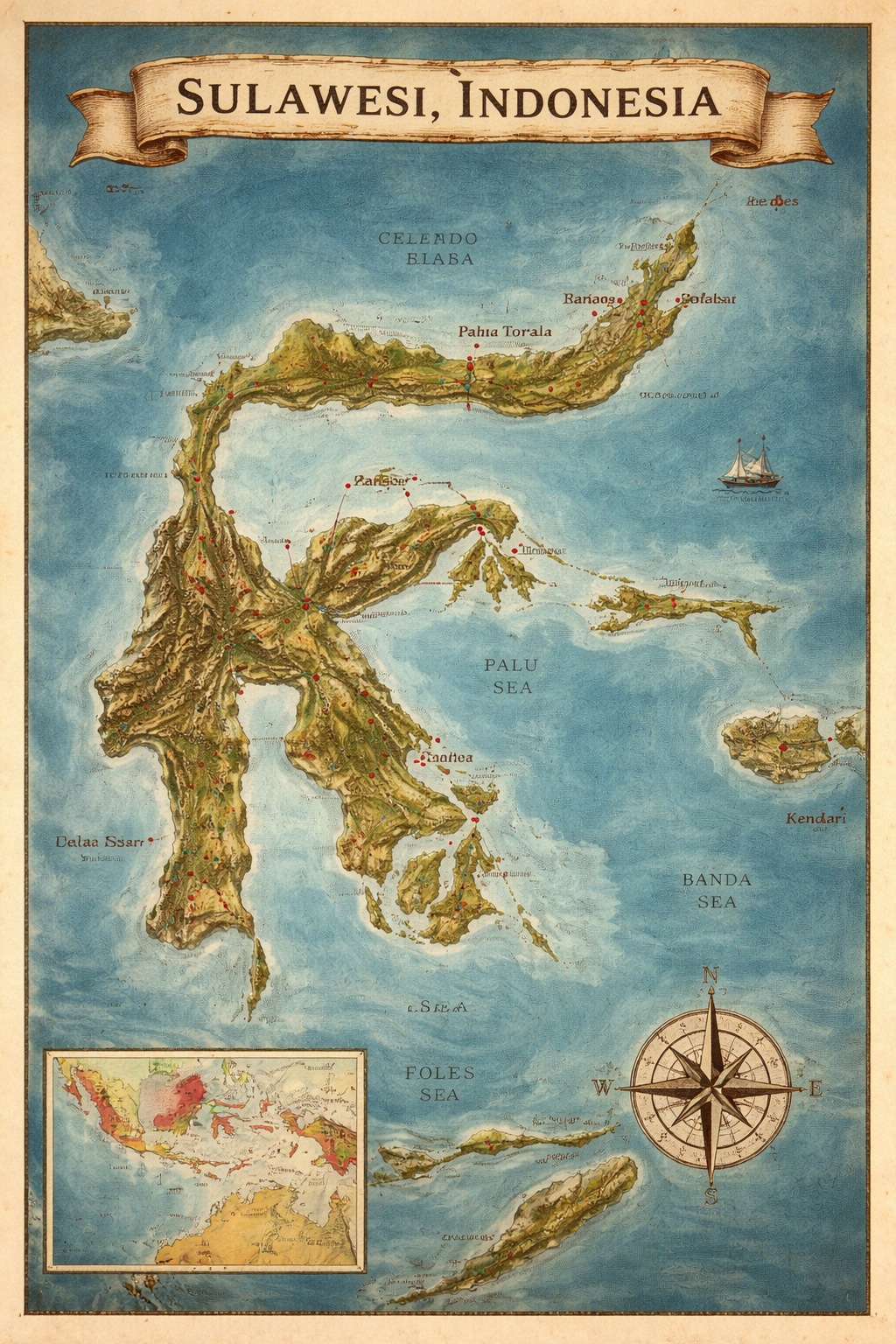 In a limestone cave on a small tropical island off the coast of Sulawesi, Indonesia, a faded patch of reddish pigment measuring just 14 by 10 centimetres has upended our understanding of when humans first began to create art. The remnants of fingers and a partial palm, barely visible on the cave ceiling, had been overlooked for years in a site already well known for its prehistoric paintings. It took a new generation of dating technology to reveal what was hiding in plain sight: the oldest known example of cave art anywhere in the world, created at least 67,800 years ago.
The discovery, published in January 2026 in the journal Nature, is the work of an Indonesian and Australian research team led by archaeologist Adhi Agus Oktaviana of Indonesia's National Research and Innovation Agency (BRIN) and Maxime Aubert of Griffith University in Australia. The team documented and dated rock art motifs from 44 cave sites across southeastern Sulawesi, including 14 previously unknown locations. But it was a single hand stencil in the Liang Metanduno cave on Muna Island—a site open to tourists and long studied by archaeologists—that produced the most extraordinary result.
The implications extend far beyond the dating of a single image. This discovery pushes back the confirmed timeline of human artistic expression by more than 16,000 years, provides the strongest archaeological evidence yet for modern human presence in the island corridors between Asia and Australia during this period, and reinforces a growing scholarly consensus that the origins of complex symbolic thought may lie not in Europe, as once assumed, but in the tropical landscapes of Southeast Asia.
The Art Itself: Simple Technique, Profound Intent
The hand stencils at Liang Metanduno were not "painted" in any conventional sense. They were created using the stencil technique, one of the most ancient and widespread forms of image-making known to archaeology. The artist pressed a hand flat against the cave wall and then blew or sprayed pigment—in this case a reddish ochre derived from iron oxide—around it, leaving the negative outline of the hand on the rock surface. When the hand was removed, what remained was an absence: the shape of a human presence defined by the colour surrounding it.
What makes the Sulawesi stencils distinctive, however, is an additional element that appears to be unique to the island. In many of the hand prints found across the region, the fingertips have been deliberately modified to appear pointed and claw-like, resembling animal talons rather than human digits. The research team is confident this is intentional artistic manipulation rather than the result of natural degradation over millennia. Adam Brumm, an archaeologist at Griffith University and co-author of the study, has suggested that these modifications may reflect a desire to blur the boundary between human and animal—a symbolic impulse with deep resonance in later Sulawesi art.
This interpretation is not speculative fancy. In 2019, the same research team reported finding rock art at another Sulawesi site depicting therianthropes—figures with human bodies and animal heads or tails—hunting wild pigs and the island's endemic dwarf buffalo, the anoa. Those narrative scenes, later redated to at least 51,200 years old using the same laser-ablation technique, demonstrated that the inhabitants of Sulawesi were capable of imagining beings that did not exist in the physical world. The clawed hand stencils at Liang Metanduno, created at least 16,000 years earlier, suggest that this capacity for symbolic transformation may have even deeper roots.
Notably, the rock art panel at Liang Metanduno also contains evidence of repeated use across vast stretches of time. A second hand stencil located just 11 centimetres from the oldest example, created with darker pigment, yielded a minimum date of approximately 60,900 years ago. Above it, a separate pigment layer dated to around 21,500 years ago. The two painting episodes are separated by at least 35,000 years, demonstrating that generations of people returned to the same spot to create art over a period longer than all of recorded human history.
The Science of Dating Shadows
One of the most significant aspects of the Muna Island discovery is the sophistication of the method used to establish its age. The research team did not attempt to date the ochre pigment itself—iron oxide is inorganic and cannot be subjected to radiocarbon dating, the technique most commonly associated with archaeological chronology. Instead, they targeted the thin layers of calcium carbonate (calcite) that had gradually formed over the pigment through natural mineral deposition.
The method, known as laser-ablation uranium-series dating (LA-U-series), was co-developed by Aubert and Renaud Joannes-Boyau of Southern Cross University specifically for application to cave art. It works by firing a laser with a spot diameter of approximately 44 micrometres at a polished cross-section of the calcite crust, vaporising minute samples without requiring chemical preparation. The laser measures the ratio of thorium-230 to uranium isotopes within the sample. Since uranium is soluble in groundwater and is incorporated into calcite as it crystallises, while thorium is not, any thorium present in the sample must have been produced by radioactive decay after the calcite formed. By measuring the degree of disequilibrium between the two elements, researchers can calculate when the mineral layer was deposited.
Because the calcite formed on top of the pigment after the art was created, the dates obtained represent minimum ages—the artwork itself is certainly older than the mineral crust sealing it. In the case of the Liang Metanduno hand stencil, the calcite yielded a uranium-series date of 71,600 years ago, with a margin of error of 3,800 years, establishing a minimum age of 67,800 years.
This LA-U-series approach represents a significant advance over earlier solution-based uranium-series methods, which required physically excavating small portions of the calcite with a rotary tool. The laser technique is faster, less destructive, and offers far greater spatial resolution, allowing researchers to identify and avoid areas where uranium may have been remobilised by water infiltration—a process that could distort age estimates. It was this same refined method that enabled the team to redate the famous hunting scene at Leang Bulu' Sipong 4 in southwestern Sulawesi from a minimum of 43,900 years to at least 50,200 years in 2024.
Dethroning Europe: The Shifting Geography of Human Creativity
For most of the twentieth century, the study of prehistoric art was dominated by European sites. The spectacular painted caves of Lascaux in France (approximately 17,000 years old) and Altamira in Spain (around 36,000 years old) defined scholarly and popular understanding of when and where humans first began to create complex images. The narrative was implicitly Eurocentric: art, and by extension higher cognitive function, was something that emerged when modern humans arrived in Western Europe.
That narrative has been progressively dismantled over the past decade, with Sulawesi at the centre of the revolution. The new Muna Island finding is approximately 16,600 years older than the previously oldest dated rock art from the Maros-Pangkep caves in southwestern Sulawesi, and roughly 1,100 years older than hand stencils found in Maltravieso cave in Spain that had been controversially attributed to Neanderthals. It comprehensively establishes Southeast Asia, not Europe, as the current epicentre of the world's earliest documented artistic traditions.
Aubert has been explicit about the implications. The long-held assumption that cognitive modernity originated in Europe, he argues, was an artefact of where researchers happened to look and what dating technologies were available. European cave art was primarily created with charcoal, making it amenable to radiocarbon dating. Southeast Asian rock art, by contrast, is predominantly made with ochre, an inorganic pigment that resisted dating efforts until the development of uranium-series techniques. The technological playing field has only recently been levelled, and the results have been transformative.
The ethnoarchaeologist R. Cecep Eka Permana of the University of Indonesia, who was not involved in the study, has suggested that the hand stencils may be connected to ritual practices for warding off misfortune—traditions that persist in some indigenous communities in Sulawesi to this day. If correct, this would represent an extraordinary continuity of symbolic behaviour spanning tens of thousands of years.
The Migration Question: Whose Hands Were These?
Perhaps the most tantalising uncertainty surrounding the Muna Island discovery is the identity of the artists themselves. Two broad scenarios are under consideration, each with profound implications for our understanding of human evolution and dispersal.
The first possibility is that the hand stencils were made by anatomically modern humans—Homo sapiens—who had already begun migrating out of Africa and through Asia toward Oceania. Genetic and archaeological evidence suggests that the ancestors of Indigenous Australians and Papuans traversed the Wallacean islands—the chain of oceanic islands between the Asian and Australian continental shelves—during this period. Sulawesi sits squarely on the northern migration corridor, one of two plausible routes (the other passes through Timor and the Lesser Sunda Islands to the south) by which humans may have reached the supercontinent of Sahul, which then connected Australia, Tasmania, and New Guinea.
Oktaviana has stated that the people who created the Sulawesi paintings were very likely part of the broader population that would eventually spread through the region and reach Australia. The dating aligns compellingly with excavations at Madjedbebe in northern Australia, where stone artefacts suggest human presence between 68,700 and 59,300 years ago. If both dates are accurate, they suggest a remarkably rapid dispersal through thousands of kilometres of island-hopping across open water—a feat requiring not merely physical endurance but planning, navigation, and social organisation on a significant scale.
The second possibility is more provocative: the hand stencils could have been made by Denisovans, an archaic human group known primarily from fragmentary fossil evidence in Siberia and Tibet. Genetic studies have revealed that modern populations in Australia, New Guinea, and the Wallacean islands carry significant traces of Denisovan DNA, suggesting that Denisovans and modern humans interbred somewhere in Southeast Asia. A 2021 study of a 7,200-year-old skeleton from the Leang Panninge cave in South Sulawesi—the first ancient human DNA ever recovered from Wallacea—revealed substantial Denisovan ancestry, leading researchers to propose that Wallacea may have been a critical zone of contact and interbreeding between the two populations.
The question of Denisovan artistic capacity remains unresolved. If the Muna stencils were indeed made by Denisovans, it would dramatically expand our understanding of what archaic humans were capable of. If they were made by modern humans, it would push back confirmed evidence of Homo sapiens in Wallacea by more than 20,000 years beyond previously established dates.
A Region Barely Explored
The southeastern portion of Sulawesi where the oldest stencils were found remains largely uncharted archaeologically. The research team surveyed 44 cave sites across the region, but much of the surrounding island chain—including Muna's neighbours—has never been systematically investigated. Younger depictions found in the same caves, dating to roughly 4,000 years ago, include human figures, birds, mounted warriors, and animals resembling horses. These later works, executed in red, brown, and sometimes black pigment, testify to the endurance of artistic traditions in the region across millennia, but they represent only the most recent layer of a palimpsest that almost certainly extends much deeper into the past.
The broader Wallacean archipelago presents enormous potential for further discoveries. Hominin occupation of Sulawesi has now been documented to more than one million years ago, with stone tools suggesting that pre-modern human species—possibly ancestors of Homo floresiensis, the diminutive "Hobbit" of Flores—were already navigating these waters in the deep Pleistocene. The region's complex biogeography, defined by the deep-water channels first identified by Alfred Russel Wallace in the nineteenth century, means that any hominin reaching these islands had to cross open sea—a capability once thought to be exclusive to modern humans.
Brumm, reflecting on the discovery, emphasised how much of Sulawesi's archaeological potential remains untapped. The island and its neighbours could yield art and artefacts that push the timeline of human creativity back even further, particularly if systematic survey work extends to islands that have received little or no attention from researchers. Joannes-Boyau, who led the dating work, described the Muna finding as filling a critical gap in understanding how people first reached the Australian continent.
Not the End, but an Invitation
The Muna Island hand stencil is a profoundly humble object: a faded patch of ochre, the ghostly outline of a palm and fingers, pressed against stone in a gesture that transcends the abyss of nearly 68,000 years. It was not monumental in scale or spectacular in execution. It was, in the simplest sense, a mark—a declaration of presence, made by someone who stood in a cave on a tropical island and chose to leave a trace of themselves behind.
Yet the accumulating evidence from Sulawesi suggests that these stencils were far more than casual marks. They were part of a sustained artistic tradition, shared across communities, maintained over tens of thousands of years, and characterised by deliberate symbolic choices—the clawed fingers, the transformation of human into animal, the return to the same sacred surfaces generation after generation. They represent not the birth of art in a single inspired moment, but the deep roots of a cultural practice that would eventually encompass the narrative hunting scenes, therianthropic figures, and complex compositions that make Sulawesi's cave art among the most significant archaeological discoveries of the twenty-first century.
"For us, this discovery is not the end of the story," Aubert has said. "It is an invitation to keep looking." Given that much of Southeast Asia's island world remains archaeologically unexplored, and that each new application of laser-ablation dating technology pushes established timelines further into the past, there is every reason to believe that the oldest art yet found may not remain the oldest for long. The caves of Wallacea have been keeping their secrets for a very long time. They are only now beginning to give them up.