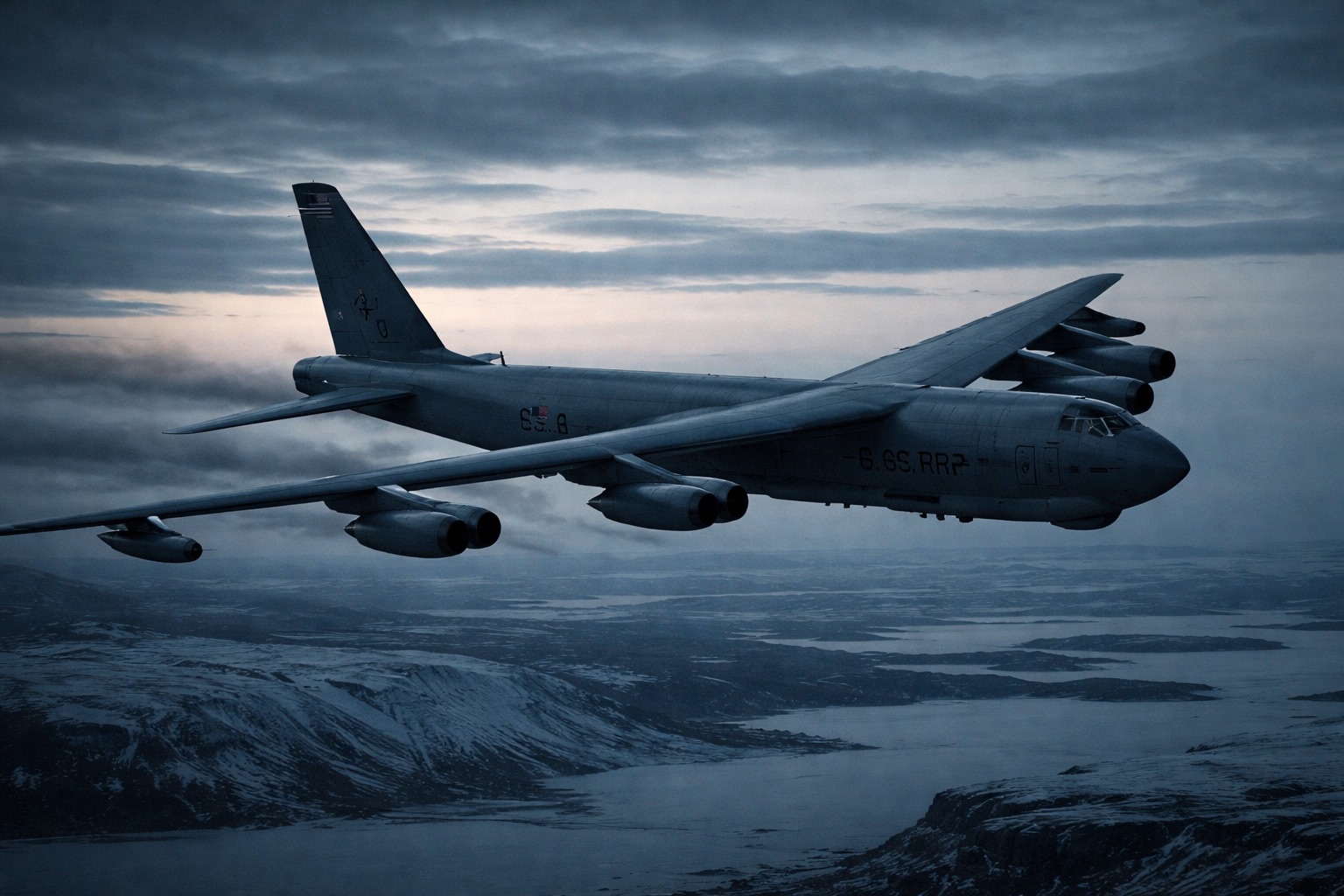
The 1968 Thule Nuclear Accident: When the US Dropped Four Hydrogen Bombs on Greenland
A 1968 nuclear accident on the Arctic territory Trump now covets reveals a history of Cold War deception, environmental contamination, and fractured alliances.
The Day the Ice Burned
A routine patrol mission over the Arctic transformed into a nuclear crisis that would poison US-Danish relations for decades and leave radioactive contamination buried beneath Greenland's ice.
On January 21, 1968, a US Air Force B-52G Stratofortress carrying four hydrogen bombs crashed onto the frozen surface of North Star Bay, seven miles from Thule Air Base. The impact triggered conventional explosions that scattered plutonium, uranium, and tritium across miles of pristine Arctic landscape. Although the weapons' fail-safe mechanisms prevented full thermonuclear detonation, the accident exposed a systematic violation of Danish sovereignty that Copenhagen had publicly forbidden: American nuclear weapons had been secretly transiting Danish territory for over a decade.
The Thule incident remains one of the most serious nuclear accidents in history, a catastrophe that killed one crew member, contaminated an Arctic ecosystem, sparked an international diplomatic crisis, and left questions that persist to this day about a missing hydrogen bomb component potentially still buried beneath the ice.
Cold War Skies: The Context of Continuous Alert
Understanding the Thule crash requires understanding the paranoid logic of nuclear deterrence that governed Cold War military doctrine.
By the late 1950s, both superpowers had developed intercontinental ballistic missiles capable of reaching enemy territory in under thirty minutes. American war planners faced a terrifying vulnerability: a Soviet first strike could destroy bombers on the ground before they could retaliate. The solution was to keep nuclear-armed aircraft airborne around the clock, ensuring that a portion of America's strategic arsenal would survive any surprise attack.
Operation Chrome Dome, initiated in 1961, maintained continuous airborne alert with B-52 bombers carrying live thermonuclear weapons flying predetermined routes along the Soviet periphery. At its peak, the operation kept twelve nuclear-armed bombers in the air at all times. The program was extraordinarily dangerous by design, placing hydrogen bombs in perpetual motion through hostile weather, mechanical systems prone to failure, and human crews subject to exhaustion and error.
The Hard Head mission that ended in disaster at Thule was one component of this larger operation. Aircraft flying the Hard Head route would orbit above Thule Air Base, monitoring the Ballistic Missile Early Warning System radar installation for signs of Soviet attack. Military planners believed that any Soviet missiles targeting North America would pass over Greenland, making Thule a critical tripwire. The bombers served dual purposes: surveillance platforms and retaliatory weapons positioned to strike the Soviet Union if the worst occurred.
This strategic calculus treated Greenland as American territory in all but name, a presumption that would prove politically explosive when the crash revealed its implications.
The Flight of HOBO 28
Captain John Hogg commanded the seven-man crew of the B-52G, designated HOBO 28, as it lifted off from Plattsburgh Air Force Base in upstate New York on the morning of January 21, 1968. The aircraft climbed to thirty-five thousand feet and settled into its patrol route, carrying four B28FI thermonuclear weapons in its forward bomb bay. Each weapon measured twelve feet in length, weighed approximately 2,300 pounds, and carried a yield sufficient to obliterate a major city.
Six hours into the mission, a decision born of discomfort would initiate catastrophe. Major Alfred D'Amario, seeking warmth in the freezing aircraft, placed foam rubber cushions near a heating vent beneath the instructor navigator's seat. He then opened an engine bleed air valve to increase cabin heat. The bomber's environmental systems failed to properly cool the superheated air from the engines, and the cushions began to smolder.
Navigator Captain Curtis Criss first detected the acrid smell of burning rubber and opened the lower compartment hatch to investigate. Flames burst outward. Criss emptied two fire extinguishers into the blaze, but the fire had already spread beyond control, feeding on rubber insulation and electrical components throughout the aircraft's lower fuselage.
At 3:22 p.m. local time, with the bomber approximately ninety miles south of Thule, Captain Hogg transmitted a distress call and requested emergency landing clearance. Smoke filled the cockpit with alarming speed, reducing visibility and forcing crew members to don oxygen masks. Five minutes later, Hogg ordered the crew to abandon aircraft.
The B-52G's ejection systems functioned as designed for six of the seven crew members. Co-pilot Captain Leonard Svitenko, however, occupied a seat without ejection capability. He attempted to escape through a lower hatch, struck his head during egress, and was unable to deploy his parachute. His body was recovered north of the base the following day, the accident's only fatality.
The abandoned bomber continued its descent, passing directly over Thule's runway lights before impacting the sea ice of North Star Bay at 3:39 p.m. The crash was not survivable for the aircraft or its payload.
Impact and Immediate Aftermath
The B-52 struck the ice at high velocity, disintegrating on impact. The collision triggered the conventional high-explosive components of all four hydrogen bombs, though the weapons' safety interlocks prevented nuclear detonation. The distinction between conventional and nuclear explosion, however, offered cold comfort to those who would deal with the consequences.
Jeffrey Carswell, an employee of a Danish contractor working at Thule, was inside a facility building when the bomber struck. The structure shook as if struck by an earthquake, he later recalled. Personnel rushed outside to witness a massive fireball rising from the frozen bay, burning aviation fuel illuminating the polar darkness.
The explosions pulverized the weapons' fissile cores and scattered radioactive material across approximately three square miles of ice. Plutonium-239, uranium-235, americium-241, and tritium contaminated the crash site at levels that would later measure in the thousands of disintegrations per minute per square meter. The intense heat of the burning fuel melted through several feet of ice, allowing contaminated debris to sink toward the seabed below.
Within hours, Thule's commander activated disaster protocols and requested assistance from Strategic Air Command headquarters. The situation presented immediate and long-term dangers: radioactive contamination spreading across the ice, the approaching Arctic spring threatening to carry contaminants into the marine ecosystem, and the diplomatic explosion certain to follow when Denmark learned what had crashed on its territory.
Diplomatic Fallout: Denmark's Nuclear Betrayal
The crash at Thule detonated a political crisis that would reverberate through US-Danish relations for decades.
Denmark had maintained an official policy prohibiting nuclear weapons on Danish territory since 1957, a position rooted in domestic politics and Cold War neutralism that successive governments had publicly affirmed. The Thule accident revealed this policy to be a polite fiction, one that both Washington and Copenhagen had tacitly agreed to maintain while American nuclear weapons routinely transited Greenland's airspace.
Danish Prime Minister Jens Otto Krag initially attempted to characterize the crash as an isolated incident, an emergency diversion rather than evidence of systematic policy violation. This narrative collapsed almost immediately under the weight of evidence. The B-52's mission profile, orbiting above Thule as part of a continuous alert operation, demonstrated that nuclear-armed overflights were routine rather than exceptional.
The Danish public reacted with outrage. Protests erupted in Copenhagen, with demonstrators demanding answers about what their government had known and when. Parliamentary inquiries revealed that Danish officials had received briefings on American nuclear operations but had chosen not to inform the public or challenge the arrangement that contradicted stated policy.
The full extent of Danish governmental complicity remained hidden until 1995, when researcher Svend Aage Christensen uncovered classified documents proving that Danish authorities had secretly authorized nuclear weapons transit despite public denials. The revelation, dubbed Thulegate by Danish media, sparked renewed political scandal twenty-seven years after the crash. Multiple government officials faced accusations of having systematically deceived parliament and the Danish people about nuclear weapons policy.
For Washington, the incident carried different but equally serious implications. The crash demonstrated that Operation Chrome Dome's risks extended beyond the catastrophic nuclear accident that had nearly occurred. Even without a nuclear detonation, the program had damaged a crucial NATO alliance, contaminated allied territory, and exposed American willingness to violate agreements with friendly nations when strategic interests demanded.
Project Crested Ice: The Cleanup
The United States initially resisted Danish demands for comprehensive remediation of the crash site, calculating that the remote location and frozen conditions might allow the contamination to remain undisturbed. This position proved untenable when Danish scientists warned that the approaching summer thaw would release radioactive material into North Star Bay, potentially contaminating fisheries along Greenland's western coast.
The cleanup operation, designated Project Crested Ice, began in February 1968 and would become one of the largest environmental remediation efforts of the Cold War era. The challenges were extraordinary. Temperatures at the crash site frequently dropped below minus forty degrees. The polar night limited working hours. The contaminated area sprawled across miles of sea ice that would begin breaking up within months.
Military engineers carved roads through the ice and constructed temporary facilities including mess halls, medical stations, and decontamination chambers. At the operation's peak, over a thousand personnel worked the crash site, many equipped with little more than basic cold weather gear and hand tools.
The work proceeded with grim determination. Airmen walked shoulder to shoulder across the frozen bay, collecting debris ranging from massive aircraft components to fragments smaller than a coin. Workers used hand tools to chip away the top several inches of contaminated ice, loading the radioactive material into steel tanks for transport. The approach was deliberately primitive, as one supervising general noted with dark irony that cleaning up one of humanity's most sophisticated weapons required almost medieval methods.
Health and safety protocols proved inadequate by later standards. Many workers handled contaminated material without proper respiratory protection. Dosimeters were in short supply. The long-term health consequences for cleanup personnel would become a source of controversy and litigation for decades.
By the time seasonal ice breakup forced the operation's conclusion on September 13, 1968, crews had removed approximately 237,000 cubic feet of contaminated ice and debris. The material was shipped to the Savannah River Site in South Carolina for processing and disposal. The total cost reached $9.4 million, equivalent to approximately $80 million today, though the human costs would prove far more difficult to calculate.
The Missing Bomb
Project Crested Ice achieved its primary objective of removing the most heavily contaminated material before the spring thaw. What the operation failed to accomplish would fuel speculation and concern for decades to come.
Initial Air Force statements claimed that all four hydrogen bombs had been destroyed in the crash and their components recovered. This assertion unraveled within weeks when investigators determined that only three weapons could be accounted for in the recovered debris.
A classified report completed in July 1968 acknowledged the discrepancy. Investigators had recovered the primary fission stages and most of the uranium from three weapons. The fourth bomb's secondary stage, the fusion component that provides a hydrogen bomb's devastating power, could not be located despite extensive searching.
The most likely explanation was that the fourth weapon had penetrated the ice on impact and sunk to the seabed before the fire consumed the crash site. North Star Bay reaches depths of over 800 feet in places, and the chaotic conditions following the crash made comprehensive underwater search impossible with 1968 technology.
The Pentagon officially maintained that all weapons had been destroyed and their hazardous materials recovered. Classified documents obtained through Freedom of Information Act requests decades later revealed that this public position was known to be false at the time it was made.
In 1979, the Danish government authorized a limited underwater survey of the crash site. The expedition located aircraft debris and contamination consistent with weapons destruction, but could not definitively confirm or deny the presence of an intact bomb component on the seabed. Subsequent monitoring has detected elevated radiation levels in sediment samples from North Star Bay, suggesting ongoing contamination from material that was never recovered.
The missing secondary stage almost certainly no longer poses a nuclear weapons risk. The tritium required for fusion ignition has a half-life of approximately twelve years and would have decayed to uselessness within decades of the crash. The fissile material, however, remains hazardous on timescales measured in millennia. Whether plutonium and uranium from the fourth bomb continue to leach into the Arctic marine ecosystem remains an open question that neither American nor Danish authorities have shown eagerness to definitively answer.
Health Consequences and Unfinished Reckoning
The cleanup workers who labored on the ice of North Star Bay paid a price that took years to become apparent.
Danish workers involved in Project Crested Ice reported elevated rates of cancer and other illnesses in the decades following the operation. A 1987 study found that cleanup personnel experienced higher mortality rates than control groups, though the limited sample size complicated definitive conclusions. Many former workers spent years seeking recognition and compensation for health problems they attributed to radiation exposure.
American veterans faced similar struggles. The Defense Department initially denied that cleanup personnel had received significant radiation doses, a position contradicted by the limited dosimetry records that survived and by the accounts of workers who described handling contaminated material with minimal protection. Veterans' groups fought extended legal and bureaucratic battles to secure recognition and benefits.
A comprehensive Danish government study completed in 2011 examined health outcomes for over 1,500 cleanup workers and concluded that participants faced elevated risks of certain cancers compared to the general population. The findings arrived too late for many veterans who had died in the intervening decades, their claims denied or ignored.
The Thule cleanup thus joined a long list of Cold War operations in which governments exposed military personnel and civilian workers to hazardous conditions while denying or minimizing the risks. The pattern would repeat with atmospheric nuclear testing, uranium mining, and numerous other activities whose health consequences emerged only after those responsible had moved on and those affected had begun dying.
The End of Chrome Dome
The Thule crash was not an isolated incident but rather the most spectacular failure in a pattern of near-disasters that had plagued airborne alert operations throughout the 1960s.
In 1961, a B-52 broke apart over Goldsboro, North Carolina, dropping two hydrogen bombs that came terrifyingly close to full detonation. One weapon's arming sequence proceeded through multiple stages, stopped only by a single low-voltage switch. In 1966, a B-52 collided with a refueling tanker over Palomares, Spain, scattering four nuclear weapons across Spanish countryside and coastal waters in an accident that required months of cleanup and strained relations with another crucial ally.
Thule provided the final impetus for reevaluation. Defense Secretary Robert McNamara had already begun questioning whether the risks of continuous airborne alert justified its strategic benefits. The diplomatic damage from successive accidents, combined with improvements in land-based and submarine-launched missiles that reduced dependence on bomber forces, shifted the calculus.
Within weeks of the Thule crash, the Pentagon suspended Chrome Dome operations pending review. The suspension became permanent. The era of routine nuclear-armed bomber patrols ended, though the aircraft and weapons remained available for alert generation during crises.
The decision represented a rare instance of military policy adapting to recognize unacceptable risk. It arrived only after multiple near-catastrophes had demonstrated that the danger was not theoretical but actual. The bombs that burned on Greenland's ice accomplished what years of internal debate had not: forcing acknowledgment that keeping hydrogen bombs in continuous motion across the planet was an invitation to disaster.
Contemporary Relevance: Greenland in the Crosshairs Again
The Thule incident has gained renewed attention amid recent American interest in Greenland that echoes, in certain uncomfortable ways, the presumptive attitudes of the Cold War era.
Former President Donald Trump's expressed desire to purchase Greenland, first voiced in 2019 and reiterated during his 2024 campaign, frames the island primarily in terms of American strategic interests. Greenland's position astride North Atlantic shipping routes, its vast mineral resources including rare earth elements critical to modern technology, and its relevance to Arctic military competition have all figured in arguments for closer American control.
Danish and Greenlandic officials have consistently rejected the premise that the territory is available for purchase, with Greenland's government noting pointedly that the island is not for sale. The response carries echoes of earlier frustrations with American willingness to treat Greenland as a strategic asset first and sovereign territory second.
The Thule accident and its aftermath demonstrated the costs of that attitude. A policy of nuclear weapons transit conducted despite explicit Danish prohibition contaminated Danish territory, killed a serviceman, and damaged an alliance that both nations considered vital. The contamination persists. The missing bomb component, if it exists, remains on the seabed. The cleanup workers are still dying.
These are not abstract historical concerns. The United States continues to operate Thule Air Base, now known as Pituffik Space Base, as a critical node in missile warning and space surveillance networks. The facility has gained importance as great power competition returns to the Arctic and as climate change opens new strategic possibilities in waters once locked beneath permanent ice.
Understanding the history of American actions in Greenland, including the accidents, the deceptions, and the environmental consequences, provides essential context for evaluating contemporary proposals. The desire to control Greenland's strategic position is not new. Neither is the willingness to subordinate local interests and alliance obligations to that desire. What remains to be seen is whether the lessons of Thule have been learned or merely forgotten.
Ice, Fire, and the Weight of History
The crash of HOBO 28 onto the ice of North Star Bay encapsulates the contradictions and dangers of the nuclear age in a single catastrophic event.
A weapons system designed to prevent war through the threat of annihilation proved incapable of preventing itself from poisoning allied territory. A policy of strategic deception, maintained for over a decade with the complicity of officials on both sides of the Atlantic, collapsed in flames when reality literally crashed through the comfortable fictions. Workers sent to clean up the mess were exposed to hazards their governments denied for decades afterward.
The fourth bomb, if it lies on the seabed of North Star Bay, serves as an apt metaphor for the unfinished business of the nuclear era. The immediate danger has passed. The weapon cannot detonate. But the contamination persists, leaching into the environment at rates too slow to command attention but too steady to ignore. The costs continue to accumulate, borne by ecosystems and communities that had no voice in the decisions that created them.
Nearly sixty years after the crash, the ice of Greenland keeps its secrets. The cleanup workers have mostly passed away, their struggles for recognition largely concluded one way or another. The diplomatic wounds have scarred over if not fully healed. American bombers no longer circle above Thule carrying hydrogen bombs.
But the strategic calculations that placed those bombers there remain operative. The appetite for control over Greenland persists. And the lesson that treating allied territory as a convenient staging ground for dangerous operations carries costs that outlast the Cold War's end seems perpetually in need of relearning.
The ice remembers what policymakers prefer to forget. In the Arctic darkness, contamination from a 1968 crash continues its slow migration through sediment and seawater, a monument to decisions made in distant capitals by people who never imagined they would be held accountable for the consequences.