Turkey's Democratic Crisis: Life Under Erdoğan as Elections Face Uncertain Future
A journey through a nation caught between Atatürk's democratic legacy and Erdoğan's authoritarian drift
I heard this phrase many times in Ankara and Istanbul. The prevailing view seems to be that if Erdoğan fails to achieve the constitutional changes that would allow him to be re-elected, he will solve this "minor" problem the same way Alexander did a few thousand years earlier in Gordium, just outside Ankara: quite simply, there will be no more elections.
The Ghost of Atatürk
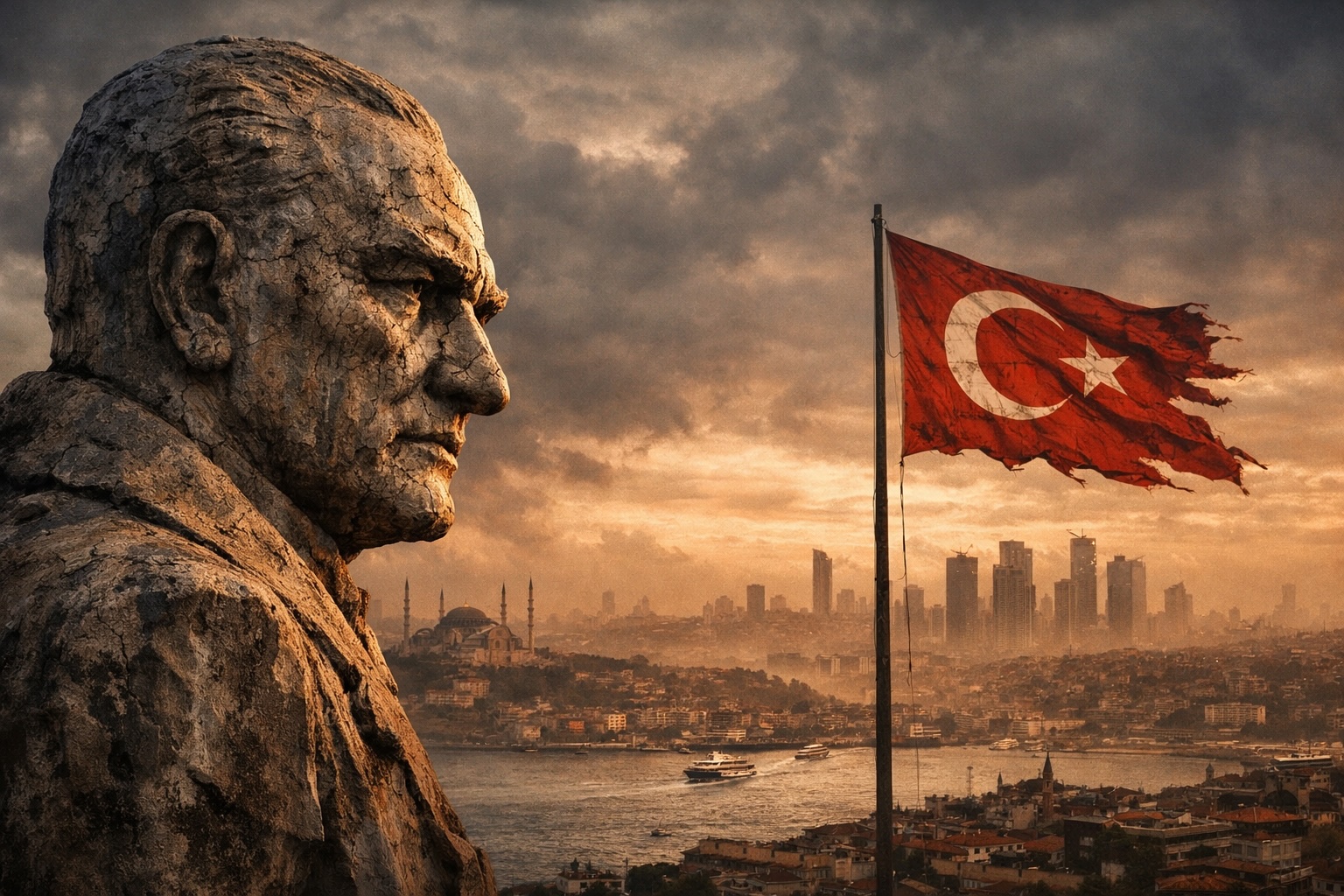
Among the many contrasts of modern Turkey, perhaps the most striking is the omnipresent figure of Mustafa Kemal Atatürk at a time when almost all Kemalists languish in prison. From posters, banners, calendars, and photographs—in shops, government buildings, and private homes—Atatürk gazes down upon today's Turkey in infinite solitude. The founder of the republic, the man who dragged a crumbling Ottoman remnant into secular modernity, now presides over a nation systematically dismantling his vision.
There are many things no one discusses openly anymore. The name Ekrem İmamoğlu, the popular Istanbul mayor whom many once saw as Erdoğan's most credible challenger, is spoken only in whispers. So too is that of Fethullah Gülen, the cleric-in-exile whose movement the government blamed for the 2016 coup attempt and whose alleged followers have been purged from every institution. No one openly criticizes Erdoğan; yet discontent surfaces constantly through sidelong glances and expressions of weary acquiescence. The Turks seem to be gradually abandoning their century-old experiment in democracy—not because they do not want it, but because of a corrosive combination of fear and economic desperation.
An Economy in Freefall
The lira continues its relentless descent, dragging everyday life down with it. Turkey is no longer a cheap country—not even for visitors carrying euros. Inflation runs rampant, housing in the major cities has become prohibitively expensive, and imported products are now luxuries reserved for the wealthy. The black economy reigns supreme, with transactions conducted either "approximately" in the ever-depreciating local currency or—far more commonly—in euros and dollars.
The currency is losing value so rapidly that certain price points no longer correspond to actual banknotes. Coins serve only a symbolic purpose, their purchasing power having evaporated. When I ask people how anyone survives on the minimum wage of 23,000 lira—roughly 500 euros per month—no one has a satisfactory answer.
What appears to be saving the economy, at least superficially, is that Turkey manufactures nearly everything domestically, functioning like a "mini-China." From food to cheap textiles, from passable imitations of Italian designer clothing to sophisticated military drones, the country has developed a remarkable degree of economic self-sufficiency. This introversion provides jobs on one hand and offers economic alternatives in daily life on the other. In supermarkets, imported "foreign label" products—paper towels, sanitary items, cosmetics—sit on shelves at prices several times higher than their Turkish equivalents. Most shoppers don't even glance at them.
Some insist that "after the pandemic, the economy is doing much better." These tend to be people who have caught the wave of either the tourism boom or secured government contracts. The state, meanwhile, cuts ribbons with relentless enthusiasm: new highways, soaring bridges, gleaming hospitals, high-speed rail lines, a nuclear power plant, energy hubs, and an ever-expanding defense industry. All of it creates an impression of galloping progress that somehow fails to reach the pockets of ordinary Turks.
The Pan-Turkic Dream
Erdoğan, for his part, seems to be in the Caucasus every other week, clasping hands with the leaders of various "-stans"—Azerbaijan, Kazakhstan, Turkmenistan, Uzbekistan. From these relationships, he extracts two things of immense value. The first is cheap energy: gasoline costs roughly one euro per liter, cities blaze with light like permanent Christmas displays, and homes stay heated through the brutal Anatolian winters. The second is a national narrative: all of these are Turkic peoples, bound by language and heritage, and who could be their natural leader if not the original Turkey?
This neo-Ottoman, pan-Turkic vision has been woven into education, media, and political discourse for over two decades. It provides something that economic hardship cannot easily erode: a sense of purpose, of historical destiny, of a nation reclaiming its rightful place at the center of civilizations.
I want to ask my interlocutors how the feeling of being a victim nation—surrounded by hostile forces, constantly plotted against—can be reconciled with the aggressive promotion of Pan-Turkism and regional hegemony. But I already know the answer, for it has been tried again and again throughout history. By convincing a people that they are threatened and perpetually wronged, you can lead them almost anywhere.
Contrasts That Cut
In practice, poverty coexists with ostentatious wealth in contrasts more jarring than ever before. Cities swell as the countryside empties. Discontent grows even as it is systematically suppressed. Hope calcifies into resignation.
"Let's see what happens in the elections," I say to a businessman in the tourist-friendly affluence of Cappadocia, where hot air balloons drift over fairy chimneys and ancient cave churches, and money flows freely from foreign credit cards.
He replies with unsettling calm: "Why? Will there be another election?"
The question is not rhetorical. The prevailing view among those willing to speak candidly is that if Erdoğan cannot secure the constitutional changes necessary to extend his rule—including through his recent tactical rapprochement with Kurdish political factions—he will simply ensure that the question never arises. The Alexander solution: when you cannot untie the knot, cut it.
Democracy Behind Bars
In Ulucanlar Prison, you cannot escape the thought that democracy in Turkey is rapidly eroding beneath the gaze of the man who created it. The prison was founded in 1925, carved into the rock beneath Ankara Castle, and served for decades as the destination for political prisoners and dissidents under successive military dictatorships.
Its famous "tenants" included the poet Nazım Hikmet, Turkey's greatest literary voice, who spent years within these walls for the crime of his communist beliefs. The filmmaker Yılmaz Güney created some of his most celebrated scripts here. Bülent Ecevit, the prime minister who ordered the invasion of Cyprus in 1974, also knew these cells—a reminder that Turkey's relationship with democracy has always been complicated, its civilian governments periodically interrupted by military "corrections."
Today, the prison is a museum. Thousands of Turks file through daily, examining the cramped cells, the instruments of torture, the gallows from which nineteen political prisoners were hanged. What do they think when they see these relics of authoritarianism? Perhaps some imagine that if Turkey had completed its European journey, had fulfilled the promise of EU accession that once seemed tantalizingly close, everything would be different today.
Atatürk appears here too, as he appears everywhere—this time as a life-size wax figure observing the Second Turkish Grand National Assembly, itself preserved as a museum. School groups stream through constantly, children in uniforms receiving their lessons in republican history. A life-size wax Atatürk gazes from the gallery at the empty chamber where his revolution once took institutional form.
The Nationalist Generation
There are still those who envision a European, modern future for Turkey—secular, democratic, integrated with the West. But you notice a shift even among younger generations. After decades of relentless state propaganda, even among the most progressive segments of the population, there exists a widespread, mild but uncompromising nationalism.
"Don't get me wrong," says an IT student in Ankara who has demonstrated against Erdoğan and considers himself liberal. "I love my country and I want to protect it. Various people have always been plotting against us."
Here lies the key point that Western observers consistently miss: we tend to believe that if Erdoğan falls, Turkey will automatically revert to a fully democratic, European-oriented nation—a close ally with no designs on anyone's sovereignty, a reliable NATO partner, a bridge between civilizations. This fantastical geopolitics ignores that Turkish national identity runs far deeper than any single leader. The narratives of greatness, of victimhood, of encirclement by enemies—these predate Erdoğan and will outlive him. "Any other solution" is not necessarily the solution we imagine.
Istanbul Under Pressure
A few days later, on the ferry crossing the Bosphorus—that narrow strait where Europe and Asia face each other across waters traveled by civilizations for millennia—someone tells me I've arrived in Istanbul at just the right moment.
"In a few days, we'll be swamped with tourists."
Tourism exerts enormous pressure on this ancient city. "The cost has become unbearable for us," says a couple who own a shop in Karaköy, the once-gritty port district now transformed into a landscape of boutique hotels and artisanal coffee shops. "The city has changed enormously in recent years." They do not mean for the better.
Overtourism divides Turks much as it divides us in our own overcrowded destinations. "Tourists are destroying this place," says the guide on my first day in the mythically beautiful landscape of Cappadocia. "The monuments and the ground cannot withstand the crowds. They're falling apart." But the next day, a different guide offers a different perspective as we stand in the center of an underground city carved into volcanic rock, where thousands of people lived as cave-dwellers until the 1960s: "Tourism is good. It brings money. People here used to be desperately poor."
The state eventually relocated those underground communities to social housing when the soft volcanic rock began collapsing on their inhabitants. That history points to another crisis: housing. There are still entire neighborhoods of informal settlements in Turkish cities—shantytowns clinging to hillsides, structures built without permits, communities with uncertain legal status. To demolish them, all these people must go somewhere. And that "somewhere" grows more elusive by the day.
A Nation Divided Against Itself
Turks remain hospitable people, and many still offer tea in their shops and strike up conversations with evident pleasure. Yet increasingly, others ignore visitors or display open hostility toward foreigners. The warmth that once seemed universal now feels selective, conditional.
Turkey is a country in daily conflict with itself, like the tectonic plates grinding beneath its soil—plates that have produced devastating earthquakes throughout history and will produce more. The cosmopolitanism of the great cities and Mediterranean beaches clashes with the ancient conservatism of the Anatolian heartland. Religious traditionalism wrestles with European progressivism. Atatürk's vision of a secular, Western-facing republic confronts Erdoğan's dream of neo-Ottoman restoration.
Eighty million people find themselves trapped between a glorious yesterday, a bewildering today, and an uncertain tomorrow. The monuments to past greatness stand everywhere—Hagia Sophia, now a mosque again after decades as a museum; the palaces of sultans; the fortresses of Byzantines and Seljuks and Ottomans. History here is not past but present, a weight pressing down on every decision about the future.
Will there be another election? The question hangs in the air of every whispered conversation, every careful non-answer, every glance toward the nearest portrait of Atatürk—that founder who promised democracy and modernity, whose legacy now serves mainly as decoration in a country drifting toward something else entirely.
Turkey will never cease to be a land of contradictions. The only question is which contradictions will define its future—and whether its people will have any voice in deciding.