Shadow Fleet: How Russia Built a Parallel Shipping Empire
How international sanctions on Iran, Russia, and Venezuela gave rise to—or rather accelerated—the creation of a parallel, shadow maritime transport network, why regulation alone proved insufficient, and what the transition from rules to enforcement signifies for the future of global trade.
The End of a Single Maritime World
For decades, we considered international shipping to be a single, unified space: common standards, shared insurance frameworks, recognized registries, accessible ports, and agreed-upon rules. A space where differences were resolved institutionally and violations addressed through regulation. Disputes went to arbitration. Insurance claims followed established protocols. Flag states bore responsibility for their vessels. The system was imperfect, but it functioned on a basic assumption: participation in global trade meant acceptance of global rules.
This image no longer holds true.
Today, two worlds coexist—and increasingly clash—at sea. On one hand stands institutional shipping, governed by an intricate network of rules, responsibilities, and predictability. The International Maritime Organization sets standards. Classification societies certify vessels. Protection and indemnity clubs provide insurance. Port state control inspections enforce compliance. This system moves approximately 80% of global trade by volume, and its participants accept its constraints because they value its protections.
On the other hand, a parallel fleet has emerged—organized, disciplined, and surprisingly functional—operating entirely outside the regulatory framework. The so-called "shadow fleet" is not an anomaly or a temporary workaround. It is the deliberate product of adaptation to a world where sanctions lack universal enforcement. It represents something more fundamental than sanctions evasion: a proof of concept that global trade can occur without Western institutional architecture.
Origins: From Iranian Innovation to Russian Scale
The creation of the shadow fleet was neither accidental nor gradual. It was deliberate, rapid, and built upon existing foundations.
Iran deserves recognition as the pioneer. Following the reimposition of American sanctions in 2018, Tehran developed the operational playbook that would later be adopted and scaled: ship-to-ship transfers in international waters, systematic deactivation of Automatic Identification System transponders, frequent changes of vessel names and flags, document falsification, and cargo "mixing" to obscure origin. Iranian operators learned to exploit the gaps between jurisdictions, the delays in information sharing, and the reluctance of many states to enforce rules that didn't serve their interests.
Venezuela followed a similar path, though with less sophistication and smaller scale. The Maduro government found ways to export crude despite American sanctions, often through the same networks and methods Tehran had pioneered.
But it was Russia's entry into this parallel system that transformed it from a marginal workaround into a genuine alternative architecture.
From 2022, when Western sanctions on Russian oil combined with a price cap of $60 per barrel and a ban on access to Western insurance, financing, and maritime services, Moscow faced an existential dilemma: accept a drastic loss of revenue that would cripple its war effort, or build an alternative transport system capable of moving millions of barrels daily.
Russia chose the latter—and executed with remarkable speed.
Within eighteen months, Russia assembled a fleet of over 600 vessels operating outside Western oversight. This was not improvisation. It was industrial-scale logistics adaptation, drawing on state resources, intelligence capabilities, and the expertise of operators who understood exactly which pressure points in the institutional system could be circumvented.
It is worth noting that this shift was not simply a product of sanctions. Sanctions accelerated and massified a direction already set: the gradual disengagement from the Western regulatory, financial, and insurance framework. Moscow had watched Washington weaponize the dollar-based financial system for years. It had observed how SWIFT access could be revoked, how correspondent banking relationships could be severed, how insurance markets could be closed. The shadow fleet is not only a tool for sanctions circumvention—it is a rehearsal for operating in a world of reduced dependence on Western rules.
The Market Provided the Means
The shadow fleet would not have gained scale without one critical element: available material. Politicians designed sanctions on the assumption that control over the shipping industry would suffice to constrain Russian oil exports. They overlooked a basic market reality.
There already existed an aging global fleet of tankers—vessels fifteen, twenty, twenty-five years old, ships that had been written off by major operators, approaching the end of their insurable life, destined for scrapping yards in Alang or Chittagong. Under normal circumstances, these vessels would have been worth little more than their steel weight.
When buyers appeared willing to pay prices far exceeding scrap value—sometimes two or three times what the vessels would fetch for demolition—without asking questions about age, classification status, or future employment, the market reacted as markets always do: quickly and without sentiment.
Greek shipowners, historically dominant in the tanker trade, sold extensively. So did owners in Norway, Germany, and elsewhere. In many cases, these sales violated no explicit prohibition at the time they occurred. Shell companies registered in the UAE, Hong Kong, or various offshore jurisdictions appeared with cash. Transactions closed within days. Vessels changed hands, changed names, changed flags, and vanished into the shadow system.
This does not make these sales politically neutral. In hindsight, they proved crucial to the formation and rapid expansion of a fleet now financing Russia's war. The sellers bear no legal liability—but the strategic consequences of their commercial decisions are undeniable.
Politicians designed sanctions assuming regulatory control would suffice. The market had already secured the means for circumvention.
Operational Architecture of the Shadow Fleet
The shadow fleet does not operate on the margins or through improvised measures. It has developed a systematic, sophisticated mode of operation that exploits every gap in international maritime oversight.
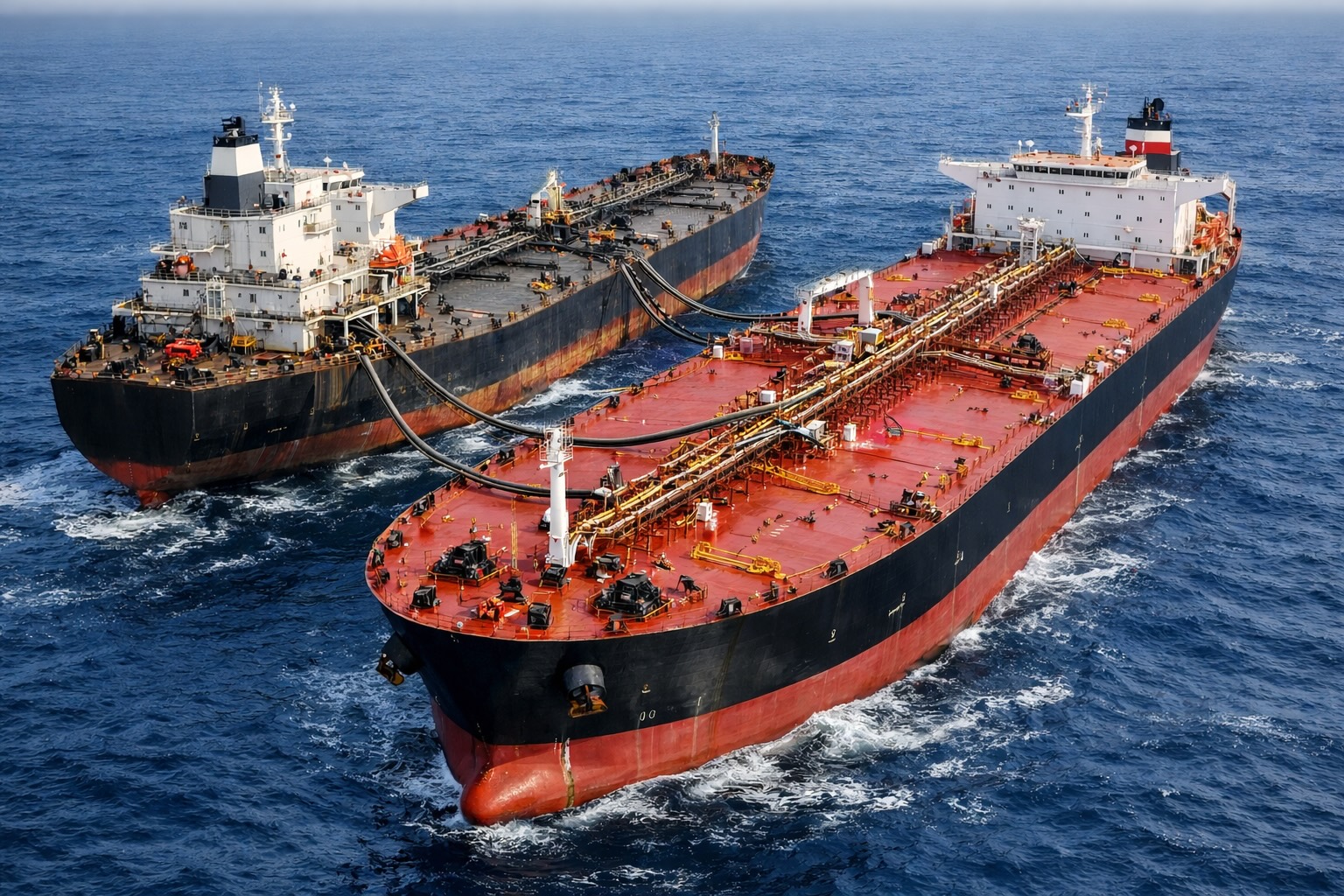
Ship-to-ship transfers form the backbone of the system. Vessels rendezvous in international waters—beyond any nation's jurisdiction—to transfer cargo. The Laconian Gulf off Greece, waters off Ceuta, areas near Singapore, and zones off the Malaysian coast have all served as transfer points. Oil loaded in Russian ports moves to an intermediate vessel, which may transfer it again before the cargo reaches its final destination. Each transfer obscures origin, complicates tracking, and creates deniability for the ultimate buyer.
Identity manipulation is constant. Vessels change names frequently—sometimes multiple times per year. They switch flags between registries known for minimal oversight: Cameroon, Gabon, Palau, and various Pacific island states that sell registrations without meaningful inspection requirements. Ownership passes through chains of shell companies registered in jurisdictions chosen specifically for opacity.
AIS manipulation has become an art form. The Automatic Identification System was designed for maritime safety, not sanctions enforcement. Shadow fleet vessels routinely disable their transponders, broadcast false positions, spoof their identities, or simply go dark for days or weeks while conducting transfers or loading at sanctioned ports. When they reappear, their stated positions often bear no relationship to their actual movements.
Documentation fraud completes the picture. Certificates of origin are falsified. Bills of lading show cargo loaded in ports the vessel never visited. Quality certificates are fabricated. Insurance documents reference policies that may not exist or that were obtained through misrepresentation.
The crucial point is political: the shadow fleet is not defined by the oil it transports, but by its purpose and structure. Today, it primarily serves Russia, Iran, and Venezuela. Tomorrow, it could serve any producer outside the official system—or any buyer willing to accept the risks of operating beyond institutional frameworks. This is infrastructure for a parallel global trade system, not a temporary exception.
The Limits of Regulation
The European Union invested primarily in regulation: rules, lists, restrictions on services. This approach worked within the institutional world. European banks stopped financing Russian oil trades. European insurers stopped covering Russian cargoes. European port authorities increased inspections and turned away vessels suspected of sanctions violations.
But regulation assumes a shared framework. It assumes that actors wish to remain within the system, that they value access to regulated markets, that they fear exclusion from institutional arrangements. Against a parallel mechanism that has no reason to comply—that has, in fact, organized itself precisely to operate without compliance—regulation accomplishes little.
The price cap illustrates this limitation perfectly. The G7 concept was elegant: Russian oil could still flow, but only at prices below $60 per barrel, enforced by denying Western shipping, insurance, and financial services to cargoes sold above the cap. In theory, this would deprive Russia of windfall profits while maintaining global supply.
In practice, Russia simply built alternative supply chains. Shadow fleet vessels carry Russian oil to India, China, and Turkey at prices negotiated bilaterally—often well above the cap. Russian and alternative insurers provide coverage. Non-Western banks handle financing. The cap applies only to those who choose to remain in the institutional system. For those who have exited, it is irrelevant.
The result is not sanctions failure in the traditional sense. Russian oil revenues have declined from their peaks. The costs and friction of operating outside the institutional system are real. But the strategic objective—forcing Russia to choose between revenue and compliance—was not achieved. Instead, Moscow demonstrated that a parallel energy economy could function: higher risk, higher cost, but sufficient profit, as long as that risk remained manageable.
The American Turn: From Rules to Enforcement
This is where the transatlantic divide becomes politically significant.
The United States is moving from a paradigm of "record-prohibit-restrict" to one of "touch material, incur costs." American enforcement is no longer aimed primarily at achieving compliance with rules. It targets the mechanism itself: specific ships, specific cargoes, specific insurance schemes, specific intermediate hubs.
The Treasury Department's Office of Foreign Assets Control now designates individual vessels by name. The designations carry consequences: any port that receives a designated ship risks secondary sanctions. Any insurer that provides coverage faces exclusion from the American financial system. Any company that facilitates the trade—even unknowingly—may find itself subject to enforcement action.
The targeting is selective but deliberately unpredictable. OFAC does not designate every shadow fleet vessel—that would be impossible and would dilute the impact. Instead, it designates enough vessels, with enough variety in their profiles and operations, that participation in the shadow fleet transforms from a calculable risk into a potentially catastrophic one.
This is not punishment for violating rules. This is the deliberate dismantling of infrastructure.
The January 2025 sanctions package exemplified this approach. The Treasury designated over 180 vessels in a single action—the largest maritime sanctions package in history. The targets included not only tankers but also the trading companies that chartered them, the insurers that covered them, and the executives who managed the operations. The message was unmistakable: the entire ecosystem faces consequences.
Britain's Maritime Enforcement and the Bending of International Law
The recent British decision to authorize Royal Navy vessels to board ships of the Russian shadow fleet in the English Channel represents a characteristic case of bending international law to serve strategic purposes.
The rules are not abolished or directly violated. They are interpreted functionally to permit physical enforcement where regulation has proven inadequate.
Under normal circumstances, a vessel flying a recognized flag enjoys the protection of that flag state. Boarding requires consent, or evidence of specific crimes (piracy, slavery, certain drug offenses), or authorization from the flag state. The shadow fleet exploits this protection by using flags of convenience from states that have neither the capacity nor the interest to supervise their registered vessels.
Britain's legal innovation invokes the concept of vessels without a genuine link to their flag state—ships that fly flags obtained through pure commercial convenience, without any real administrative connection to the registering country. Such vessels, the argument runs, do not deserve the same protections as legitimately flagged ships. Their crews can be questioned. Their documentation can be inspected. Their cargoes can be verified.
This does not signal a change in maritime rules. It signals a shift in purpose: from maintaining maritime order as an end in itself, to dismantling a mechanism that finances conflict. The English Channel—one of the world's busiest waterways—becomes a chokepoint not just for geography but for enforcement.
The precedent matters beyond the immediate context. If Britain can board shadow fleet vessels in the Channel, what prevents other states from doing the same in their waters? What happens when the shadow fleet must route around an increasing number of enforcement zones? The operating space contracts; the costs increase; the model becomes less sustainable.
Ukraine's Direct Action: Energy Logistics as Military Target
Ukrainian strikes on ships and infrastructure linked to Russian oil exports add a second dimension of physical cost—one that exists entirely outside the sanctions framework.
Here we have not regulation, not enforcement, but the stark acknowledgment that energy logistics has become part of the conflict itself. When Ukrainian drones strike Russian refineries, when missiles target loading terminals, when naval drones attack tankers in the Black Sea, the message is direct: the financing of Russian military operations will face physical disruption.
This represents a different theory of pressure. Sanctions work through incentives and restrictions within an economic framework. Military action works through destruction. The shadow fleet can circumvent sanctions by accepting higher costs. It cannot circumvent a missile.
The legal and ethical complexities are significant. Attacking civilian merchant vessels raises questions under the law of armed conflict. But Ukraine's position is clear: these vessels carry cargo that finances the war. They are not neutral commercial actors. They are participants in a system that sustains Russian military operations.
Whether or not one accepts this logic, its practical effect is undeniable. Shadow fleet operators now face not only regulatory risk and sanctions risk, but physical risk. Crews demand higher wages. Insurers—such as they are—price in the possibility of attack. Routes through contested waters become less attractive. The operating environment grows more hostile.
Strategic Dimensions: China and the Parallel System
There is a broader strategic interpretation that extends beyond Russia.
The dismantling of the shadow fleet serves American interests that go beyond punishing Russian sanctions evasion. It also targets the ultimate beneficiaries of opaque energy flows.
China has emerged as the primary buyer of discounted Russian oil. Chinese refineries—particularly the independent "teapot" refineries that account for a significant share of the country's processing capacity—have access to crude at prices well below global benchmarks. This cheap energy provides a competitive advantage for Chinese industry, subsidizes Chinese manufacturing, and strengthens Chinese economic resilience.
In this sense, American enforcement against the shadow fleet serves as an indirect tool to limit China's ability to reap strategic benefits from a parallel system that undermines Western rules-based architecture. The cheap oil flowing to Chinese ports is not just a Russian revenue stream—it is a Chinese competitive advantage. Disrupting that flow serves multiple objectives simultaneously.
India presents a more complex case. Indian refiners have also purchased heavily from the shadow fleet, processing Russian crude and often re-exporting refined products to markets that might refuse direct Russian supply. Washington has shown more tolerance for Indian purchases, reflecting India's importance as a strategic partner and the pragmatic recognition that New Delhi will not sacrifice its economic interests for Western policy objectives.
This selective enforcement reflects the underlying reality: sanctions and their enforcement are instruments of power, not neutral applications of rules. They are deployed strategically, with attention to consequences and relationships, not mechanically against all violations.
Implications for Maritime Hub States
For countries with significant maritime presence—flag registries, shipping industries, port facilities, shipyards—the division of shipping into two worlds is not an abstract geopolitical development. It directly affects the balance between economic activity, institutional compliance, and strategic risk.
As international shipping ceases to function as a single regulatory field, pressure increases on hub states to take a stand—not through diplomatic statements, but through operational choices.
Consider the position of a major flag registry. Shadow fleet vessels seek flags from states that will not scrutinize their operations or cooperate with Western enforcement efforts. Providing such flags brings registration fees and some economic benefit. But it also risks designation, reputational damage, and potential exclusion from institutional arrangements that the state values.
Consider the position of a shipyard. Shadow fleet vessels need maintenance, repair, and eventually replacement. Servicing this fleet brings revenue. But it also risks sanctions exposure, loss of access to Western technology and financing, and association with operations that finance conflict.
Consider the position of a bunkering port. Shadow fleet vessels need fuel. Providing it brings business. But ports known as shadow fleet hubs face increased scrutiny, potential designation, and reputational damage that affects their broader commercial relationships.
In this environment, vigilance and consistent enforcement of the regulatory framework cease to be mere formal obligations. They become elements of strategic credibility—signals to partners about where a state positions itself in the emerging division between institutional and parallel systems.
The Sustainability Question
The shadow fleet is not going to disappear overnight. It has proven more resilient, more sophisticated, and more adaptable than many analysts expected. But it is not sustainable as a long-term, low-risk regime.
The physical constraints are real. Old ships do not become younger. The vessels that form the backbone of the shadow fleet—many of them already twenty years old when acquired—are approaching the end of their operational lives. Hulls fatigue. Engines wear. Safety systems become unreliable. The recent increase in shadow fleet casualties—groundings, fires, mechanical failures—is not coincidental. These are old ships, poorly maintained, operated at high intensity, carrying dangerous cargo.
Fleet renewal presents a fundamental problem. Building new tankers requires shipyards, financing, and technology—all of which are concentrated in countries that participate in the institutional system or that face their own pressures not to assist Russian sanctions evasion. South Korean and Japanese yards will not build vessels for the shadow fleet. Chinese yards could, in theory, but Beijing has reasons to avoid becoming the explicit infrastructure provider for Russian sanctions circumvention.
Insurance presents similar constraints. The shadow fleet operates with coverage from Russian insurers and from various alternative providers of uncertain reliability. This coverage may prove adequate for routine operations. But a major casualty—an oil spill, a collision, a loss of life—could expose the hollowness of these arrangements. The institutional insurance market exists precisely because maritime risks are too large for any single party to bear. Shadow fleet operators are betting they can avoid catastrophic events. Eventually, that bet will lose.
Enforcement pressure is cumulative. Each sanctions designation, each enforcement action, each port that increases scrutiny, each waterway that becomes more dangerous to transit—all of these accumulate. The shadow fleet adapted to the initial sanctions framework. Adapting continuously to escalating enforcement is more difficult.
The Trace Left Behind
A transitional outcome is more likely than either extreme. The shadow fleet will not disappear—but neither will it stabilize as a permanent, low-risk alternative to institutional shipping. We will likely see: fewer vessels as attrition outpaces replacement; higher costs as enforcement pressure increases; more selective use, reserved for the most valuable cargoes and the most isolated markets; and gradual fragmentation as different actors face different constraint levels.
But transitions leave traces. And the trace left by the shadow fleet is clear and permanent.
The assumption of a single maritime world—shared rules, shared infrastructure, shared participation—has been broken. The demonstration that global trade can occur outside Western institutional frameworks, with sufficient scale to sustain major economies, cannot be unlearned. The next time a major producer faces sanctions, the template exists. The next time a major buyer wants access to resources outside institutional channels, the model is proven.
From now on, the sea will be a space of power choices—not merely the application of neutral rules. The distinction between institutional and parallel shipping will remain a feature of international trade, even if the specific composition of each fleet changes. Flag states, port states, shipping companies, and insurers will face continuous pressure to position themselves on one side or the other of an increasingly defined boundary.
The world of two fleets is not permanent in its current form. It is a product of transition—of the movement from a unipolar regulatory environment to something more contested and fragmented. But the fundamental insight it represents will endure: rules matter only to those who accept them, and acceptance is always, ultimately, a choice.
The shadow fleet proved that choosing otherwise is possible. That proof changes everything that follows.