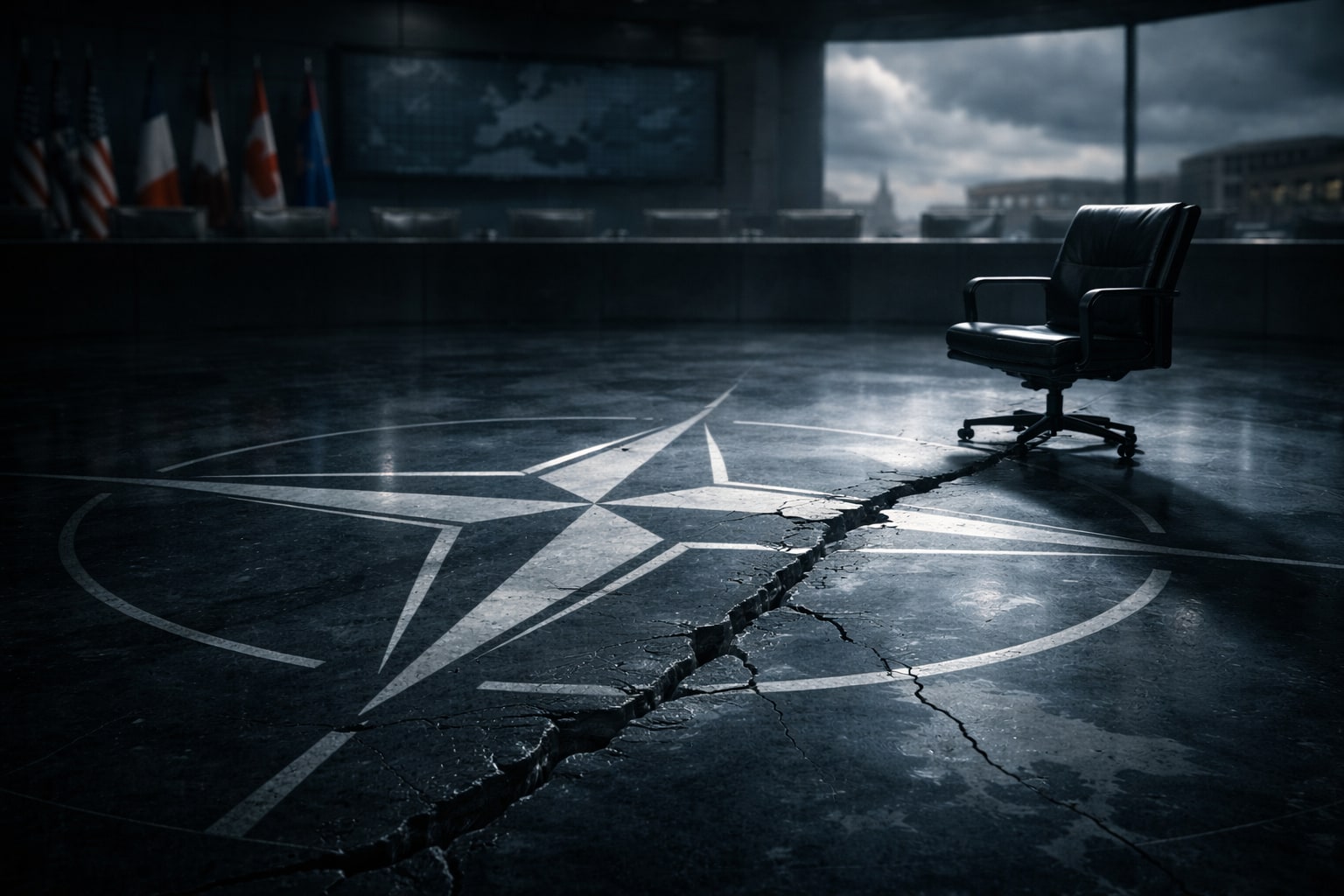
NATO: From Unrivaled Power to a Scenario of Sudden Collapse
The alliance built to contain Moscow now faces a threat its founders never seriously imagined: abandonment from within.
On April 4, 1949, twelve governments signed a short document in Washington. Just over 2,000 words. The North Atlantic Treaty was less a diplomatic flourish than the formal admission of a new reality: that the security of Western Europe and North America could no longer be parceled out as a national matter. Ottawa, Oslo, London, Lisbon, and the rest were agreeing to something close to an insurance pool for sovereignty itself.
The backdrop was grim. Europe was economically hollowed out, politically brittle, and staring at a Soviet military machine that had already swallowed Poland, Czechoslovakia, Hungary, Romania, Bulgaria, and the eastern half of Germany. The Berlin Blockade had ended only a few months earlier. The Iron Curtain was not a rhetorical device. It was a line on a map, patrolled by conscripts, and the people who drafted NATO's founding text knew that if deterrence failed, there was no realistic plan B.
Article 5 is the article everyone remembers. An attack on one is an attack on all. In practice it was narrower and fuzzier than public memory suggests. The text commits each signatory only to "such action as it deems necessary," which is deliberately elastic. What gave it real weight was not the legal wording but the presence of American troops in Germany, American aircraft on European runways, and later American nuclear weapons stationed on European soil. The deterrent was physical. The treaty merely described it.
For four decades that arrangement held with a predictability that now looks almost quaint. Spheres of influence were mapped. Escalation ladders were studied. The Fulda Gap was war-gamed to exhaustion in staff colleges from West Point to Sandhurst. Strategic choices were awful in their stakes but orderly in their logic. NATO did not need to reinvent itself because the adversary was a fixed target and the mission was defensive. The alliance's bureaucracy in Brussels could get on with the unglamorous work of standardizing calibers, harmonizing radio frequencies, and arguing about burden-sharing percentages.
Then the Soviet Union collapsed, and with it the cleanest rationale any military alliance in modern history had ever enjoyed.
Rather than dissolve, NATO did something historically unusual. It expanded. Poland, Hungary, and the Czech Republic joined in 1999. The Baltic states, Bulgaria, Romania, Slovakia, and Slovenia followed in 2004. Albania and Croatia in 2009. Montenegro in 2017, North Macedonia in 2020. Finland and Sweden, prodded out of decades of neutrality by Russia's full-scale invasion of Ukraine, joined in 2023 and 2024. Thirty-two members now. The geographic center of the alliance has drifted nearly 800 kilometers east of where it sat in 1989.
With expansion came mission creep. The interventions in Bosnia and Kosovo during the 1990s were the first operational deployments of an alliance built for a war that never came. September 11 triggered the only invocation of Article 5 in NATO's history, and the resulting two decades in Afghanistan turned the alliance into something it was never designed to be: a global expeditionary force conducting counterinsurgency 4,000 kilometers from Brussels. Libya in 2011 confirmed the drift. Collective defense had quietly absorbed counterterrorism, state-building, and the management of regional conflicts.
By the mid-2020s, the world NATO was operating in had gone polycentric. Russia was back on the European stage as a revisionist power with nuclear weapons and a willingness to use them rhetorically if not yet in practice. China had emerged as the systemic challenger the 2022 Strategic Concept finally named explicitly. The Middle East remained a source of chronic volatility with direct consequences for European energy security. NATO's response was to keep stretching its mandate, now explicitly covering hybrid threats, cyber, space, climate-linked instability, and critical infrastructure resilience.
The Hormuz Problem
And then the Strait of Hormuz crisis of 2026 forced a conversation the alliance had been postponing for years.
The Strait is roughly 33 kilometers wide at its narrowest point. Before the current crisis, about 27 percent of the world's seaborne crude oil and around 20 percent of its liquefied natural gas passed through it. After the United States and Israel launched Operation Epic Fury against Iran on February 28, 2026, the Strait was effectively shut. Iran's Islamic Revolutionary Guard Corps mined parts of the channel, attacked merchant vessels, and issued transit prohibitions. By early March, Brent crude was trading above $120 per barrel. QatarEnergy declared force majeure on LNG exports. Combined oil output from Kuwait, Iraq, Saudi Arabia and the UAE dropped by around 10 million barrels per day by mid-March, the largest single supply disruption the International Energy Agency has ever recorded.
NATO was barely involved.
That fact alone tells you how far the alliance has drifted from the clean logic of 1949. Freedom of navigation through one of the planet's two or three most critical chokepoints is, on paper, a textbook collective security problem. In practice, the alliance fractured along almost every predictable seam. The United Kingdom initially refused to allow American forces to use British bases to strike Iran. Spain went further, blocking US military flights from two jointly operated bases and shutting its airspace to any aircraft linked to the operation, including those based in third countries. Germany sent mixed signals, with Chancellor Friedrich Merz first suggesting support and later saying the war was not Europe's fight. France kept its distance. The Italians were polite but uncommitted.
The underlying reason is not cowardice or bad faith. It is structural. European states, particularly the major economies, are net energy importers and view Hormuz as vital to their own survival. The United States, as the world's largest oil and LNG producer, has a very different exposure profile. When Washington launched a war that immediately closed the Strait and then demanded that Europeans join, European governments looked at the math and concluded that the operation was creating the very crisis it was ostensibly preventing. Whatever one thinks of that reasoning, it was not the behavior of an alliance with a shared threat picture.
The current situation is worse than a disagreement. On April 12, President Trump announced a US blockade of "any and all ships trying to enter, or leave the Strait of Hormuz," now enforced by roughly 10,000 American personnel, more than a dozen Navy vessels, and combat aircraft operating from the Gulf of Oman and the Arabian Sea. Iran lacks realistic alternatives, since over 90 percent of its $109.7 billion in annual seaborne trade transits the Strait. The International Monetary Fund cut its 2026 global growth forecast to 3.1 percent and warned of an "adverse scenario" with oil anchored near $100 a barrel. And NATO, as an institution, has nothing to do with any of this. The war is being prosecuted by the United States and Israel, with selective coalition support, through channels that have nothing to do with the North Atlantic Treaty.
The Threat of Sudden Death
Which brings us to the part that would have seemed unthinkable a decade ago.
On April 8, 2026, White House Press Secretary Karoline Leavitt confirmed that Trump "has discussed" withdrawing the United States from NATO. Days later he called the alliance "severely weakened and extremely unreliable" and "a paper tiger" on Truth Social. Secretary of State Marco Rubio told Fox News the United States may need to "re-examine whether or not this alliance that has served this country well for a while is still serving that purpose, or is it now become a one-way street." The Polish foreign ministry responded by telling its diplomats to treat US withdrawal as "a possible scenario" and plan accordingly. When the Polish government says the quiet part out loud, the situation has moved.
There are legal obstacles. The 2024 National Defense Authorization Act requires either a two-thirds Senate supermajority or a specific act of Congress before a president can formally withdraw from NATO. Ilaria Di Gioia, a senior lecturer in American law at Birmingham City University, has pointed out that Trump could try to circumvent the statute by invoking presidential foreign-policy authority under Article II, Section 2, framing withdrawal as a national security necessity. It is unclear who would have standing to sue. The Supreme Court precedent is thin. President Carter's 1979 withdrawal from the mutual defense treaty with Taiwan survived a legal challenge, which cuts in Trump's favor.
A formal exit is not really the danger, though. The danger is that Trump does not need to leave to break the alliance. The Wall Street Journal reported on April 9 that the administration is weighing the closure of at least one US base in either Spain or Germany as retaliation for their positions on Iran, with troop relocations to Poland, Romania, Lithuania and Greece under consideration. Nearly 40,000 US service members are stationed in Germany, including the staff at Ramstein Air Base, which is home to NATO Allied Air Command and functions as the coordination hub for the entire integrated air defense of Europe. Spain hosts 3,814 personnel at bases near the Strait of Gibraltar, including five Navy destroyers at Rota that are the backbone of NATO's Aegis Ashore ballistic missile defense system. Moving Rota's mission to Souda Bay in Greece would take years and billions of dollars in new infrastructure. And that is assuming anyone builds it.
What Europe cannot replace on any relevant timeline is the part of American power that does not show up in troop numbers. The United States operates 246 military satellites; the European members of NATO operate 49, of which 15 belong to France. American C4ISR systems, the strategic command, control, communications, computers, intelligence, surveillance, and reconnaissance backbone, provide the real-time picture around which NATO planning is built. Aerial refueling is similar: roughly 450 US tankers against about 150 on the European side. Strategic airlift is worse. So is suppression of enemy air defenses, where no European NATO air force currently has the munitions stocks or trained crews to conduct the mission at scale. A survey of 17 European defense experts conducted by Defense News last year found that closing the space-based ISR gap alone would take five to ten years of sustained investment.
I want to be blunt about what this means, because a lot of commentary dances around it. Europe is not defenseless. France and the United Kingdom together hold around 515 nuclear warheads across eight ballistic missile submarines. European NATO members field approximately 2,100 combat aircraft. Aggregate European defense spending reached €481 billion in 2026, which is larger than the combined military budgets of Russia and China. The ReArm Europe plan, announced in March 2025, aims to mobilize €800 billion over four years through a €150 billion loan instrument called SAFE, fiscal flexibility worth up to €650 billion, and a Savings and Investment Union designed to redirect some of the €300 billion in European household savings that currently flows offshore every year. At the Hague summit in June 2025, every NATO member except Spain committed to spending 5 percent of GDP on defense and security by 2035, split into 3.5 percent for core military spending and 1.5 percent for related infrastructure.
These are serious numbers. They are also not enough, not quickly enough. Money is not capability. A new air defense battalion takes years to stand up; training a single F-35 pilot takes longer than a two-term presidency. Germany only removed its constitutional debt brake for defense spending in 2025. The European defense industrial base, hollowed out by three decades of peacetime procurement cycles, is still scaling. The EU's financial watchdog has warned that even the European Defense Industry Program lacks the budget to meet its stated objectives and that at least €500 billion will be needed over the next decade just to close existing capability gaps. Mark Rutte, NATO's secretary general, warned in Berlin in December 2025 that Russia could be ready to use military force against a NATO member within five years. The most charitable reading of European rearmament timelines is that they are racing the Russian clock. The honest reading is that they are losing.
If the United States walks, and by "walks" I mean either formal withdrawal or the functional equivalent through troop pullouts, intelligence restrictions and a public rejection of Article 5, the consequences land in roughly four waves. First, the security vacuum on NATO's eastern flank. Poland, the Baltic states and Finland have collectively become some of the most militarized societies in Europe, but their deterrence math assumes American reinforcement. Without it, Russia's window for coercion, hybrid pressure, or limited land grabs widens. Second, the nuclear question. France has already begun cautious conversations about extending its deterrent umbrella over European partners. No French president will ever make that guarantee as unconditionally as an American one. The UK's nuclear force is designed differently and depends operationally on US cooperation for warhead maintenance. Third, the energy and shipping picture. The collapse of transatlantic coordination makes every future Hormuz, every future Bab el-Mandeb, and every future Taiwan Strait scenario harder to manage. Fourth, the political object itself. The West, as a coherent strategic bloc, stops existing. Countries that spent 80 years betting on the American security guarantee begin hedging, and they hedge in directions that include Beijing.
Senator Thom Tillis put it plainly when he said a US withdrawal would fulfill the "greatest dreams" of Putin and Xi while undermining American security. He is correct. This is also, in my view, the most under-appreciated aspect of the current moment. NATO has survived Suez, de Gaulle's withdrawal from the integrated command, the Euromissile crisis, the end of the Cold War, the Iraq War split of 2003, and Trump's first term. It has adapted each time. What it has never faced is the deliberate withdrawal of its largest and most capable member as an act of policy rather than an accident of politics.
The question people keep asking is whether NATO can adapt. That is the wrong question. NATO has adapted more times than any comparable institution in modern history. The real question is whether it can survive the deliberate removal of the pillar that every one of those adaptations silently depended on. Unlike every previous crisis, this threat is not coming from Moscow, or from terrorism, or from a shifting global order. It is coming from the capital city where the alliance was born.
That is a genuinely new situation. It is not clear that seventy-seven years of institutional muscle memory are any use against it.